According to that surreal 140-character world that is Twitter (I wrote it off as a waste of cyberspace, but now I’ve signed up I’m hooked), Jenson Button has been sunning himself in Hawaii this winter.
I’m sure he’s been training hard being the masochistic triathlon-loving sort of bloke he is, but I hope he’s enjoyed a break too. It’s been well earned after the incredible (and long) season he’s just driven through.

I wonder what he was up to when news broke that both Jaime Alguersuari and Sebastien Buemi were facing immediate unemployment following Scuderia Toro Rosso’s decision to drop them for doing little wrong, but not quite enough right? I’d like to think that whether he’d just returned from a run, swim or cycle – or was in fact propping up a bar drinking something colourful with an umbrella sticking out the top – that he’d taken a moment to consider: ‘it so easily could have been me not so long ago’.
Alguersuari and Buemi might well pitch up somewhere else on a Formula 1 grid in the future, but for now there appears to be an oh-so-real chance that Red Bull has spent years grooming these two for stardom, only to chew them up and spit them out before either have got anywhere near their mid-twenties. I feel sorry for them. But not too sorry. As Alguersuari so eloquently put it in his post-sacking statement, there are an awful lot more people worse off in the world right now. Racing is hard, and if you don’t deliver, you’re out. Fact.

Button knows. He could have been cast afloat at the end of his disappointing sophomore season at Benetton when he was just 21 years old. After the bright promise of his rookie season at Williams, he found himself in the ejection seat through no fault of his own because Juan Pablo Montoya had always been earmarked to partner Ralf Schumacher in 2001. Instead, Button was placed at Flavio Briatore’s team – and almost sunk in a car that was both uncompetitive and set up for Giancarlo Fisichella. He was just a ‘playboy’, with just two World Championship points to his name.
It could have ended then, and again at the end of his next season, if he hadn’t made a career-saving deal with David Richards and BAR.

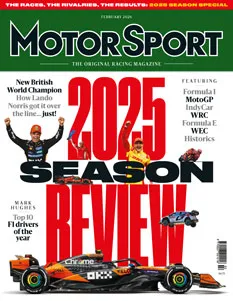
Then, most famously, he was almost out of the game at the end of 2008 when Honda gave up on F1 – and was even briefly linked to a drive at Toro Rosso, until clever old Ross Brawn pulled off the trick of the century and gave him a team and a car good enough to win that most unlikely World Championship. And now look where he is, in his ‘happy place’ at McLaren, as we put it in our 2011 F1 season review issue of Motor Sport. Just incredible.
Perhaps Alguersuari and Buemi should take heart from Button’s example – perhaps not. As we discuss in our review (which went to press before they were sacked), they never convinced anyone at Red Bull that they were ready to step up to the ‘A-team’ alongside champion Vettel – which is exactly why two more youngsters, Jean-Eric Vergne and Daniel Ricciardo, have been pitched in to try their luck instead. A convoluted stream of circumstances kept Button in the game, which often had little to do with his level of talent, but the STR rejects might not be so lucky.
As for both Vergne and Ricciardo, they are touted to deliver, but will they? Talent alone won’t see them through.

Our Button interview shows once again how fortunate we are in this era to be watching such a talented bunch of top-liners at the sharp end who have a high degree of respect for one another. Jenson speaks candidly to David Tremayne about his main rivals and what they are like to race against. Vettel, Hamilton, Alonso, Webber… who, in his opinion, is the toughest opponent? Read the interview to find out.
Beyond the modern F1 stuff, we’re particularly proud of the 50th anniversary celebration of sports car racing at Daytona in this February issue. Now, we’re careful not to say we’re marking a half-century of the Speedway’s 24-hour enduro, because we can’t, of course. The first Daytona 24 Hours didn’t take place until 1966, but as Gary Watkins explains ahead of his excellent selection of the great races, sports cars were introduced to the Speedway in 1962 with a three-hour race, to justify the use of ‘International’ in the official title of the track. Daytona’s sports car race has never, and will never, be as big a deal as NASCAR’s great 500-miler – but it’s got a special character of its own, and it’s that which we celebrate this month.
Elsewhere, Simon Taylor listens to tales of Cosworth over lunch with Mike Costin; Andrew Frankel tries the all-new Porsche 911 (which is actually called the 991 for some reason); and in Reflections editor-in-chief Nigel Roebuck recalls a few choice memories of his old friend Innes Ireland. Now there’s another man whose career swung on rejection at a critical stage of his career.
The difference in Ireland’s case was that he lost his drive just after he’d won a Grand Prix… Fair? It’s never had a place in F1, has it?


After the disappointment of this years Christmas Autosport magazine this looks like a cracking edition of Motorsport . Well done to all concerned for a nice blend of old and new , F1 and other motorsport and just the right amount of road cars . Just hope the Christmas post doesn’t hold it up .
Re Damien’s comment that the upcoming Daytona 24 is the 50th anniversary of sports car racing at Daytona; it is NOT. 2012 may be the 50th anniversary of the progenitor of the 24 Hour race, but it is NOT the 50th anniversary of sports car racing at the track. The track opened in 1959. In April, 1959, there was a 1000 Km professional USAC Road Racing Division sports car race. It was won by Roberto Mieres and Antonio Von Dory in a Porsche RSK. Later that year, in November, 1959, the SCCA held its season ending, championship deciding, National at Daytona. It was won by Alan Connell in a Ferrari 335-S.
The next season, 1960, SCCA held a couple Regional events at the track, plus once again its season ending SCCA National. That was won by Augie Pabst in a Meister Brauser Scarab, with Harry Heuer second in the second Meister Brauser Scarab.
1961 saw more regionals, plus another SCCA National, this won by Bob Holbert in a Porsche RS-60 Spyder. Further, in 1962, weeks before the first Daytona Continental, another SCCA National was held, this won by Alan Connell in his somewhat strange Maserati T-61/Ferrari V-12 concoction.
So, your statement is well off the mark. Sports car racing had been regularly held at Daytona for three years prior to the event that you say was the first. There were several races, five of National significance plus some regionals, at the track that all predated your statement of the Continental being the first.
Well, consider yourself told off by irate Tom. 53 years it is then!
I’ve attended a number of Daytona 24 hr races and the facility has continually improved where today it is one of the three or four best in the world (Indy is also one). The weather can be chilly (30s-40s F) or warm and up to the 80s mid day. A great place to witness the race either from the infield or a few hours in the grandstand. And the Grand Am cars, initially slighted, are providing increasingly great racing and larger fields along with the GTs. A worthwhile trip for UK sports car fans.
Right you are, Daniel. Just keeping the facts straight.
Been a fan of Jenson since he first stepped into F1. I admire the guy as he’s always carried himself with class and dignity and even in the dark days at Honda rarely if ever said anything negative. His loyalty was rewarded in 2009, and as someone who thinks Lewis is overrated and needs to shut up and drive, it’s been great to see Jenson quietly putting Lewis, frankly, where he belongs.
Ok, ok! This has been bugging me all over Christmas. Fair cop, Tom. I was being so careful to avoid an error by claiming 50 years of the 24 Hours (which it obviously isn’t), that I didn’t consider the SCCA races held before the first international in 1962 – which is why the anniversary is being marked this year. So I should have prefixed 50 years of SPORTS CAR racing with the word INTERNATIONAL. As our story explains, the ‘Continental’ was created to put Daytona on the international racing map, and as a British-based magazine that’s what we’re kind of interested in. But reprimand duly noted.
By the way, and totally by coincidence, Tom’s own photos of Can-Am at Road America in 1967 will feature in the March issue of the magazine in one of our ‘Private View’ specials. They’re fab. Tom, hopefully their inclusion in our next issue will assuage your anger!