


‘Charlie hands over control and I’m flying a Spitfire out over the English Channel’
When Andrew Frankel was given the chance to get ‘air’ of a different kind by testing a (non Triumph) Spitfire he grabbed the joystick with both hands

LOWLYT media
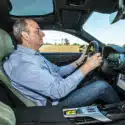
The vibration is as extraordinary as the noise is deafening and we’re not even in the air. But I guess that’s what you get when there’s 1500bhp’s-worth of 27 litres of two stage supercharged, quad-cam, 48-valve Merlin up front doing the talking.
I’m in a Supermarine Spitfire Mk IX, a real warbird which flew, attacked and was attacked in World War II, about to take off from what was once known as RAF Westhampnett, better known today as the Goodwood Aerodrome, and the very place from which Douglas Bader departed in a Spitfire for his last flight of the war. He was lucky enough to survive his encounter with the enemy and saw out the conflict in a variety of POW camps; 544 of his fellow fighter pilots in the Battle of Britain never came home again.

This two-seater was originally a single-seater, allocated to 315 Sqn (Deblin), a Polish squadron at Northolt in 1942.
LOWLYT media
This is a date I’ve waited 25 years to fulfil. In 2000, I was going to fly in one to celebrate the 60th anniversary of the Battle of Britain, but while I was waiting for ‘my’ aircraft to be serviced another came down. We’d just had our first child and it’s the only thing my long-suffering wife has ever asked me not to do. Now, with the children grown and gone, she’s much less bothered…
Up front sits Charlie Huke, ex-RAF and a man who’s flown over 250 different aircraft types, both fixed wing and rotary; but in a Spitfire, I sit in my own, separate cockpit where Charlie cannot be seen nor barely heard through my helmet over the roar of the Merlin. That name, incidentally, comes not from wizardry, but falconry.

Tally ho!
“It’s going to get quite noisy now,” he bellows into his microphone, “so we’ll talk again when we’re up.” And with that he throttles the Merlin up to take-over speed – about 2400rpm on my rev-counter – and releases the brakes. I see the stick between my legs jostling all around its sphere of action as Charlie corrects for bumps and gusts around the aircraft’s aerodynamic surfaces.
I look around. Stare at the dials and controls, so many whose purpose I can only guess at. Teenagers flew these into the face of the Luftwaffe, sometimes several times a day. I try to imagine the terror as I wheeled around the skies, suffering near blackout levels of g-force in my efforts to engage or evade the enemy, and realised I cannot. Today the biggest battle we’ll face is against the wind, which is building close to the allowable limit for this kind of aircraft these days.

the RAF only converted a lone Spitfire to two seater in the war; this Spit became a TR9 after restoration from 2005-20
LOWLYT media

As a single-seater, BS410 flew 35 sorties.
LOWLYT media
We lift effortlessly into the sky, borne aloft by an engine that powered not only Spitfires, but Hurricanes, Lancasters, Halifaxes, Mosquitoes and Mustangs. Surely no other single design could have had a more consequential effect on the outcome of the conflict. Ahead I can see blue sky and fluffy clouds, to the left and right Reginald Mitchell’s revolutionary elliptical wings.
“In the motoring world, in terms of its feel, the closest equivalent is a modern Formula 3 car”
We’re here to intercept another aircraft, not a Focke-Wulf FW 190 like the one this very aircraft damaged in combat, but perhaps a little more prosaically, a Cessna Caravan containing our intrepid photographer. But we can only spend five minutes parked off his starboard wing: the Caravan’s flat out, the Spitfire just chugging along as its temperatures rise. It was never meant to fly this slowly.
As soon as we’re clear Charlie hands over control, and I find myself flying a Supermarine Spitfire out over the English Channel. So I ask him what I’m allowed to do, and he simply replies that I’m in control, it is ‘my’ aircraft and within bounds of what is safe and sensible, I can do what I damn well like.

Merlin 66
LOWLYT media

Chocks away!
LOWLYT media
And even I realise at once what must have made this aircraft so different to those that came before it. It is unbelievably reactive, the sort of pressure on the stick you might imagine reserving for stroking a butterfly is enough to gain an instant response. Nudge it, just enough to depress the pads on your fingertips, and it’s off: up, down, left or right. In the motoring world and in terms of its feel, the closest equivalent I’ve driven is a modern Formula 3 car. Except the Spitfire can pull far greater g: over eight in combat, but no more than four today. I’ve heard it said that the heavier, more stable Hawker Hurricane was a superior gun platform and I can believe it, but you’ve got to get the enemy in your sights first and certainly when it was new, there wasn’t an aircraft in the sky better qualified for doing that than the Spitfire.
You learn at once to make sure your movements of hands and feet on the stick and rudder are as co-ordinated as can be and to issue instructions gently, but firmly: like a racing car it won’t understand indecision and will react unpredictably or not at all in its face.

Polish-American Gabby Gabreski was posted to Northolt to pilot Spitfires, flying the Mk IX frequently across the Channel.
The engine note never falters. It’s hard to believe the Spitfire emerged from the war with twice the power with which it entered it just six years earlier, by which stage the Merlin itself had become obsolete in this application and been replaced by the 37-litre Griffon engine. And while the Spitfire (single-seat) itself would stay in production until 1948, with over 20,000 built, by cessation of hostilities it had been largely superseded in performance terms, at least at low altitudes, by aircraft like the Hawker Tempest. Such is the pace of change when war is the catalyst.
My time is up so I hand back to Charlie, who performs the most beautiful victory roll before heading back to Goodwood. Upside down in a Spitfire: that’ll take some forgetting. We land right on the permissible crosswind limit and I note how furiously the stick is now being stirred as the aerodynamic surfaces start to lose their grip on the air flowing over them.
It’s over, but it doesn’t matter. Because however much I was amazed to have flown a Spitfire, I’ll cherish the memory of having done so just as much, and for rather longer.
Andrew flew with spitfires.com who are based at Goodwood and offer flights in a two-seat Spitfire from £3250.

Spitfire TR9
Converted 2020
Length 31ft 5in (9.58m)
Wingspan 36ft 10in (11.23m)
Height 12ft 8in (3.9m)
Max Take-Off Weight 3742kg
Engine Rolls-Royce Merlin 66
Maximum Speed 400mph
Range 450 miles
Service Ceiling 10,000ft