



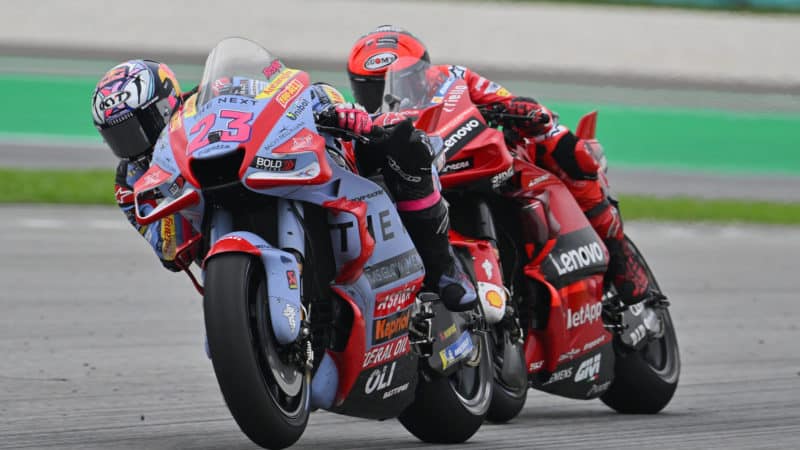
Of course, Bastianini does have his weaknesses, or at least he did last year. Both riders’ weak points and strong points can be measured exactly via data created by Dimitri Stathopoulos, a MotoGP fan and data analyst, who together with his daughter and son, Yanna and Greg, has created an app for journalists and TV commentators, to help them tell better stories for their readers and viewers. The data is also of interest to teams that want to put the performance of their riders under the microscope.
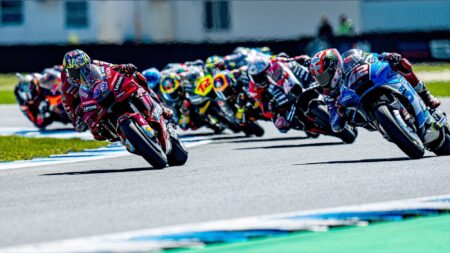
The biggest thing that Stathopoulos’s Bagnaia/Bastianini comparison data shows up is that Bastianini really needs to work on his first laps. Although the 2020 Moto2 champion is a great fighter, he isn’t on lap one.
This isn’t that unusual. Some riders are understandably nervous of asking too much of the front tyre before it’s up to full temperature. That’s why last year Bastianini often went backwards on the first lap, as riders with more confidence in the front tyre passed him, costing him vital time as he began his usual push towards the front.
Bastianini lost positions from the grid to the end of lap one at 11 of last year’s 20 races and got worse at the end of the season. This is an Achilles heel he cannot afford to have if he wants to win the title. Sure, he never lost many positions (except in the wet at Mandalika) but note from the data table below that two of his four wins – at COTA and Le Mans – were helped by advancing, not retreating, on lap one.
Enea Bastianini: lap 1 places gained in 2022
Bastianini’s first lap gains and losses. The colour coding is straightforward: green is moving forward, red is going backwards, yellow is holding position
Data: Dimitri Stathopoulos
Race |
Grid position |
Position lap 1 |
Lap 1 gain/loss |
| TOTAL | -12 | ||
| 1 – Losail | 2 | 5 | -3 |
| 2 – Mandalika | 5 | 14 | -9 |
| 3 – Termas de Rio Hondo | 12 | 11 | 1 |
| 4 – Circuit of the Americas | 5 | 3 | 2 |
| 5 – Portimão | 18 | 13 | 5 |
| 6 – Jerez | 11 | 11 | 0 |
| 7 – Le Mans | 5 | 4 | 1 |
| 8 – Mugello | 10 | 12 | -2 |
| 9 – Catalunya | 14 | 10 | 4 |
| 10 – Sachsenring | 17 | 21 | -4 |
| 11 – Assen | 16 | 13 | 3 |
| 12 – Silverstone | 8 | 11 | -3 |
| 13 – Red Bull Ring | 1 | 2 | -1 |
| 14 – Misano | 2 | 2 | 0 |
| 15 – Aragon | 3 | 4 | -1 |
| 16 – Motegi | 15 | 13 | 2 |
| 17 – Chang | 6 | 8 | -2 |
| 18 – Phillip Island | 15 | 17 | -2 |
| 19 – Sepang | 2 | 3 | -1 |
| 20 – Valencia | 13 | 15 | -2 |
No surprise that Bastianini is working on his lap-one problem during pre-season testing, after Stathopoulos bumped into him at Valencia last November and showed him the data. Obviously the first lap is more important than ever this year, due to the introduction of Saturday’s shorter sprint races, for half points.
“We are starting all sessions with used tyres and I was really fast but when we put new tyres my lap time was OK,” said Bastianini at Sepang last month. “Probably we have resolved this problem – I don’t think it will be a problem for sprint races or qualifying.”
Bagnaia did the same during testing a couple of years ago – learning to chuck the bike on its side from the very first corner.
Bagnaia was therefore much better on lap one, either advancing or holding his position in 15 races and only losing places in five. That’s a big advantage, because every overtake you need to make after the first lap will cost you time, energy and tyre. Over the full season he made four places on lap one, while Bastianini lost 12.
Pecco Bagnaia: lap 1 places gained in 2022
Data: Dimitri Stathopoulos
Race |
Grid position |
Position lap 1 |
Lap 1 gain/loss |
| TOTAL | 4 | ||
| 1 – Losail | 9 | 14 | -5 |
| 2 – Mandalika | 6 | 9 | -3 |
| 3 – Termas de Rio Hondo | 13 | 12 | 1 |
| 4 – Circuit of the Americas | 3 | 4 | -1 |
| 5 – Portimão | 24 | 21 | 3 |
| 6 – Jerez | 1 | 1 | 0 |
| 7 – Le Mans | 1 | 2 | -1 |
| 8 – Mugello | 5 | 8 | -3 |
| 10 – Sachsenring | 1 | 2 | -1 |
| 11 – Assen | 1 | 1 | 0 |
| 12 – Silverstone | 5 | 4 | 1 |
| 13 – Red Bull Ring | 2 | 1 | 1 |
| 14 – Misano | 5 | 3 | 2 |
| 15 – Aragon | 1 | 1 | 0 |
| 16 – Motegi | 12 | 12 | 0 |
| 17 – Chang | 3 | 2 | 1 |
| 18 – Phillip Island | 3 | 3 | 0 |
| 19 – Sepang | 9 | 2 | 7 |
| 20 – Valencia | 8 | 6 | 2 |
However, the situation reverses after the first lap. Bastianini’s ability to surge forward as the race goes on is well known. He does this by using a lot of front tyre, which saves his rear tyre for better performance later in the race.
Enea Bastianini: 2022 gains and losses from lap 2 to finish
Data: Dimitri Stathopoulos
Race |
Lap 2 position |
Race position |
Lap 2 to end gain/loss |
| TOTAL | 65 | ||
| 1 – Losail | 5 | 1 | 4 |
| 2 – Mandalika | 14 | 11 | 3 |
| 3 – Termas de Rio Hondo | 11 | 10 | 1 |
| 4 – Circuit of the Americas | 3 | 1 | 2 |
| 6 – Jerez | 11 | 8 | 3 |
| 7 – Le Mans | 4 | 1 | 3 |
| 10 – Sachsenring | 21 | 10 | 11 |
| 11 – Assen | 13 | 11 | 2 |
| 12 – Silverstone | 11 | 4 | 7 |
| 14 – Misano | 2 | 2 | 0 |
| 15 – Aragon | 4 | 1 | 3 |
| 16 – Motegi | 13 | 9 | 4 |
| 17 – Chang | 8 | 6 | 2 |
| 18 – Phillip Island | 17 | 5 | 12 |
| 19 – Sepang | 3 | 2 | 1 |
| 20 – Valencia | 15 | 8 | 7 |
Bastianini made up an impressive 65 positions from lap two to the chequered flag in the 16 races he finished. The only time he didn’t progress was at Misano, where he started second and finished second, after nearly tailgating winner Bagnaia on the last lap. Another moment that had Ducati management in a froth!
Bagnaia’s performance from lap two onward looks less impressive, but there is a caveat: when you qualify on the front two rows (like he did at 11 of the 15 races he finished) and you are strong on lap one, you have less overtaking to do.
Pecco Bagnaia: 2022 gains and losses from lap 2 to finish
Data: Dimitri Stathopoulos
Race |
Lap 2 position |
Race position |
Lap 2 to end gain/loss |
| TOTAL | 21 | ||
| 2 – Mandalika | 9 | 15 | -6 |
| 3 – Termas de Rio Hondo | 12 | 5 | 7 |
| 4 – Circuit of the Americas | 4 | 5 | -1 |
| 5 – Portimão | 21 | 8 | 13 |
| 6 – Jerez | 1 | 1 | 0 |
| 8 – Mugello | 8 | 1 | 7 |
| 11 – Assen | 1 | 1 | 0 |
| 12 – Silverstone | 4 | 1 | 3 |
| 13 – Red Bull Ring | 1 | 1 | 0 |
| 14 – Misano | 3 | 1 | 2 |
| 15 – Aragon | 1 | 2 | -1 |
| 17 – Chang | 2 | 3 | -1 |
| 18 – Phillip Island | 3 | 3 | 0 |
| 19 – Sepang | 2 | 1 | 1 |
| 20 – Valencia | 6 | 9 | -3 |
While examining the performance of Bagnaia and Bastianini, it’s worth putting them in context, by comparing them to the rest of the grid below.
This gives us some surprising numbers, with Alex Márquez the lap-one king of 2022, while arguably the most talented riders in MotoGP – brother Marc and Fabio Quartararo – both made net losses on the first lap.
Again, a caveat: a fast rider is more likely to make up loads of places if he starts from a lowly grid position. Which is the main reason why all the riders that gained places on lap one qualified, on average, outside the top ten, except Bagnaia.
2022 first lap gains and losses for all riders.
Data: Dimitri Stathopoulos
Rider |
Race gain/loss |
Completed first laps |
Avg grid position |
| TOTALS | 126 | 474 | |
| Alex Márquez | 91 | 20 | 18.4 |
| Darryn Binder | 83 | 20 | 22.7 |
| Miguel Oliveira | 60 | 20 | 14.3 |
| Brad Binder | 49 | 20 | 12.1 |
| Joan Mir | 37 | 15 | 10.9 |
| Takaagi Nakagami | 32 | 15 | 14.9 |
| Raul Fernandez | 31 | 18 | 22.1 |
| Alex Rins | 28 | 18 | 10.7 |
| Pol Espargaró | 23 | 18 | 13.5 |
| Remy Gardner | 22 | 20 | 20.3 |
| Pecco Bagnaia | 4 | 19 | 5.7 |
| Andrea Dovizioso | 1 | 14 | 19.3 |
| Cal Crutchlow | 1 | 6 | 17.7 |
| Danilo Petrucci | 1 | 1 | 24.0 |
| Franco Morbidelli | 1 | 20 | 16.7 |
| Kazuki Watanabe | 1 | 1 | 23.0 |
| Fabio Quartararo | -3 | 19 | 5.3 |
| Michele Pirro | -3 | 2 | 17.3 |
| Stefan Bradl | -3 | 7 | 20.0 |
| Takuya Tsuda | -3 | 1 | 21.0 |
| Tetsuta Nagashima | -5 | 4 | 21.8 |
| Lorenzo Savadori | -6 | 5 | 22.6 |
| Jack Miller | -8 | 20 | 6.1 |
| Enea Bastianini | -12 | 20 | 9.0 |
| Marc Márquez | -16 | 12 | 6.3 |
| Luca Marini | -20 | 20 | 10.2 |
| Jorge Martin | -21 | 20 | 5.6 |
| Aleix Espargaró | -26 | 20 | 6.3 |
| Fabio Di Giannantonio | -44 | 20 | 14.5 |
| Maverick Viñales | -51 | 20 | 11.3 |
| Johann Zarco | -58 | 19 | 6.0 |
| Marco Bezzecchi | -60 | 20 | 10.0 |
Next, examining the entire grid’s performance from lap two to the finish pulls up another surprise: Maverick Viñales made more gains than anyone else, including Bastianini – 80 passes to his rival’s 65. However, if Viñales’ performance seems super-impressive we need to balance it against his lap-one number, which is really bad – minus 51! – so his full-race distance gain was only 29 places, against Bastianini’s 53.
2022 gains and losses from lap 2 to the finish for all riders.
Data: Dimitri Stathopoulos
Rider |
Race gain/loss |
Completed race count |
Avg grid position |
| TOTALS | 704 | 394 | |
| Maverick Viñales | 80 | 18 | 11.3 |
| Enea Bastianini | 65 | 16 | 9.0 |
| Raul Fernandez | 58 | 16 | 22.1 |
| Andrea Dovizioso | 52 | 12 | 19.3 |
| Johann Zarco | 47 | 15 | 6.0 |
| Brad Binder | 44 | 19 | 12.1 |
| Franco Morbidelli | 42 | 15 | 16.7 |
| Alex Rins | 40 | 15 | 10.7 |
| Remy Gardner | 40 | 18 | 20.3 |
| Miguel Oliveira | 37 | 18 | 14.3 |
| Marco Bezzecchi | 36 | 17 | 10.0 |
| Darryn Binder | 27 | 13 | 22.7 |
| Pecco Baanaia | 21 | 15 | 5.7 |
| Aleix Espargaró | 18 | 19 | 6.3 |
| Cal Crutchlow | 16 | 6 | 17.7 |
| Alex Márquez | 15 | 16 | 18.4 |
| Stefan Bradl | 15 | 6 | 20.0 |
| Lorenzo Savadori | 13 | 4 | 22.6 |
| Marc Márquez | 13 | 10 | 6.3 |
| Fabio Quartararo | 10 | 17 | 5.3 |
| Fabio Di Giannantonio | 7 | 16 | 14.5 |
| Takaagi Nakagami | 7 | 13 | 14.9 |
| Luca Marini | 5 | 19 | 10.2 |
| Tetsuta Nagashima | 5 | 2 | 21.8 |
| Joan Mir | 4 | 10 | 10.9 |
| Michele Pirro | 4 | 2 | 17.3 |
| Danilo Petrucci | 3 | 1 | 24.0 |
| Kazuki Watanabe | 1 | 1 | 23.0 |
| Jack Miller | 0 | 16 | 6.1 |
| Pol Espargaró | -7 | 14 | 13.5 |
| Jorge Martin | -14 | 15 | 5.6 |
If 2023 does turn into a two-way factory Ducati fight for the title, how long before Bagnaia and Bastianini fall out with each other? Internecine rivalries often get nastier than team-against-team rivalries because it’s a case of this town isn’t big enough for the both of us, just like it was with Valentino Rossi and Jorge Lorenzo at Yamaha a few years ago.
And you could argue that it’s harder than ever for title-fighting team-mates to remain friends, because overtaking is more difficult than it’s ever been, which forces riders to take extra risks. If there is aggro this could be the biggest challenge facing Ducati management in 2023. It’s a nice problem to have, but…
Obviously there is a crucial 2023 difference to all this data: this season Bagnaia will have the same support as last season, while Bastianini is upgraded from a year-old bike to the latest-spec Desmosedici and from a third-level team (Gresini sits behind Pramac and the factory squads in the Ducati hierarchy) to the strongest team in the paddock, with the best bike and the most engineers, especially electronic engineers, who use AI (artificial intelligence) to get the best out of bike and rider.
In other words, Bastianini should be able to perform better than he did in 2022, so long as he can cope with the extra pressure of being in the factory team with a real hope of winning the title. Last year he had fewer expectations, so he rode with less psychological stress.
The 2022 data suggests Bastianini will have the upper hand in 2023, but will that be borne out by reality?
My thanks to Dimitri, Yanna and Greg Stathopoulos for their help with this blog