Matt Bishop: He was Williams' first winning driver but so few know his name

F1
December 16, 2025

Two Australian F1 drivers who came to Europe at the same time: one became world champion, the other faded from memory. But both Alan Jones and Brian McGuire have their place in racing history

Brian McGuire in Williams FW04 during 1976 Silverstone International Trophy

McGuire in Williams FW04 at Silverstone in 1976. The pairing would go on to win at Thruxton later that year

Motor/LAT

December 16, 2025

On Saturday, just three days ago, Brian McGuire – who was born in Melbourne, Australia, on December 13, 1945 – should have been blowing out 80 candles, fielding affectionate ribbing from old rivals, and deflecting the kind of gentle hero worship that accrues in later life to men who once lived fast and drove faster. Instead, there is only the arithmetic of absence: 80 years after his birth, and 48 since his death, now there is only a slim volume of stories that remain after a life of just 31 summers, and they exist only in memory, in hearsay, in paddock lore, and in the browning pages of tattered old magazines.

McGuire is one of motor sport’s ghosts, but he is a ghost worth our summoning, because his story says something important about how thin the margins are between glory and anonymity, between a Formula 1 world champion and a name remembered only by those who were there.

Motor sport is full of such people, of course. The history books are heavy with world champions and race winners, but the sport is built on the hope and hustle of those who never quite made it. McGuire sits somewhere in between: by no means a household name, but not an also-ran either; not a footnote, but a paragraph that too few bother to read. That is a shame because, if racing is a tapestry, it is the near-misses, the might-have-beens, and the men and women who lived on the cusp, who give it texture and depth. So McGuire mattered. He mattered then, and he matters now.

He was born in that great antipodean crucible of racing talent, where courage is a currency and understatement a virtue. Like many ambitious young Australians of his era, he understood early that if you wanted to measure yourself properly, if you ached to find out just how good you really were, you had to board a plane bound for England. That was where the teams were, where the competition was fiercest, where the opportunities lay, and whither ambitious drivers from all over the world therefore made beelines. For all of them the journey was a leap of faith, but such bold steps have always been a prerequisite for racers who reckoned that they had what it took to succeed on the global stage. McGuire took that leap alongside his best mate, a fellow Melburnian, Alan Jones, in 1966. Brian was 21, Alan 20.

Brian McGuire portrait

McGuire moved to Britain in 1966…

Motor/LAT

Alan Jones portrait

…along with Alan Jones

Grand Prix Photo

The Jones-McGuire friendship is one of those sliding-doors stories that motor sport historians love to ponder: two young Aussies, both quick, both raw, both tough, and both hungry, arriving in the UK together and sharing a shabby flat in Earl’s Court, west London, pooling their resources, their contacts, and, no doubt, their anxieties. Over the next decade and a half one of them would go on to become a 12-time F1 grand prix winner of ferocious commitment and unapologetic self-belief, and an F1 world champion. That was Jones. Yet in the late 1960s and early 1970s there was little to separate Jones from McGuire. Those who watched them race, who saw them scrap in Formula Ford and Formula 3, will tell you that McGuire was every bit as capable as Jones. The difference was not talent; it was timing, opportunity, and that most capricious of racing gods, luck.

McGuire was a racer in the old sense of the word. He raced because he loved it, because he had to therefore, and because life made sense to him only if he could live it at speed. He drove anything he could get his hands on, and, just like Jones, he did so with more aggression than finesse. He was also, by all accounts, quite a character: sharp-witted, convivial, unpretentious, and possessed of that laconic ocker swagger that could defuse tension or sharpen it, depending on the requirements of the moment. He was the kind of bloke you wanted to have around you.

On a damp, superfast circuit he could grab a mediocre F1 car by the scruff of its neck and bully it to victory

Like many drivers of his generation, McGuire funded his racing by any means necessary. In his case that meant buying and selling cheap road cars and running Windmill Motor Caravans of Brentford, west London, selling scruffy Volkswagen Campervans to backpacking Australians keen to explore the UK. It was a time before corporate driver academies and seven-figure sponsorship deals, when racers were entrepreneurs by necessity, and when Brian might spend a morning buying a third-hand Ford Cortina, a lunchtime selling it, and an afternoon driving an old VW Campervan to Mallory Park for a race the next day. The juxtaposition seems incongruous now, but it was entirely logical then. McGuire understood, because he had to, that racing was not only about what happened on track, but also about how you sustained yourself off it.

His motor sport career arc followed the familiar but unforgiving gradient of British single-seater racing in the late 1960s and early 1970s: Formula Ford, Formula 3, Formula 5000, Shellsport International, all of them categories through which aspiring F1 drivers might pass. He showed speed, determination, and adaptability. He won races, he lost races, he crashed, he did his own repairs, and he learned a hell of a lot.

From the archive

Then there is that curious, wonderful, and unappreciated footnote that ought to be written in bolder type. At Thruxton, in 1976, in a round of the Shellsport International championship, driving an ex-works Williams FW04, the very car that Jacques Laffite had raced to second place in the German Grand Prix at Nürburgring in 1975, McGuire qualified on the pole and took the win. On the surface it is just another result in a busy 13-round series of cheap-ish Formula Libre-status single-seater racing; just another line in an old magazine. But scratch that surface and it gleams with historical significance, because on that rainy September afternoon in Hampshire Brian McGuire became the first driver ever to win a race in a Williams.

Think about that for a moment. We are talking about Williams, that grand old F1 team starring a cast of legends: McGuire’s old mate Jones, Clay Regazzoni, Carlos Reutemann, Keke Rosberg, Nigel Mansell, Nelson Piquet, Alain Prost, Ayrton Senna, Damon Hill, Jacques Villeneuve, et al; a team of nine F1 constructors’ world championships and seven F1 drivers’ titles; a team that would come to define excellence, innovation, and resilience in F1. Yet the first race win for a Williams arrived not in a grand prix, nor even in a non-championship F1 race, but in a Shellsport International round at Thruxton, scored by an Australian whose name barely registers in the modern consciousness. It is one of those delicious ironies that the motor racing annals sometimes serve up, and it deserves to be celebrated, not forgotten.

That Thruxton victory, McGuire’s only Shellsport International win in 1976, was evidence of his ability, for it was proof that on a superfast circuit on a damp and tricky day he could grab a mediocre F1 car by the scruff of its neck and bully it to victory. It should have been a calling card. In some respects, it was. In others, it was just another moment that slipped through the cracks of a crowded sport, for, as the mid 1970s wore on, in truth McGuire was edging no closer to the top tier of single-seater racing.

He had already done two seasons of F5000, 1974 and 1975, initially in a Trojan-Chevy then in a Lola-Chevy; but, although he had bagged podium finishes, he had scored no wins. He won just that one Shellsport International race, at Thruxton in 1976, then he bought and with his own calloused hands he fettled another ex-works 1975 Williams FW04, an ex-Lella Lombardi car this time, into something that he hoped would be faster in 1977, and he renamed it the McGuire BM1. He entered nine 1977 Shellsport International rounds in that car, but it proved dreadfully unreliable and he finished just one of them, fifth at Oulton Park. He entered the same car in that year’s British Grand Prix at Silverstone, too, but it was hopelessly uncompetitive compared with the state-of-the-art F1 Ferraris, McLarens, Lotuses, and Brabhams, and he was one of six drivers who failed to pre-qualify.

Brian McGuire in McGuire BM1 F1 car at 1977 British Grand Prix

A rare shot of McGuire on track at Silverstone in 1977: he failed to pre-qualify his eponymous BM1

Getty Images

In short, he endured the highs, the lows, the hopes, the fears, the indignities and, of course, the dangers of any racing privateer’s life 50-odd years ago. It was an era in which single-seater series were unglamorous and lethal, when safety was just about beginning to improve but still very far from adequate, and when bravery was assumed and survival never guaranteed. So it was that on August 29, 1977, the Monday of the summer bank holiday weekend, in practice for a Shellsport International race at Brands Hatch, McGuire was killed in a violent accident that also claimed the life of a trackside marshal, 24-year-old John Thorpe: a grim reminder that motor sport’s risks are not borne by drivers alone. Just 15 days before, Jones had scored his maiden F1 grand prix win, at Österreichring, in a Shadow DN8. Sliding doors indeed.

McGuire was 31. His racing career, like his life, had been brutally curtailed, and consequently for ever frozen in time. We will never know what he might have become, how he might have evolved, or whether he might have found the break that his talent warranted. In truth, he might well not have done, for so few did. What we do know is that his death left a hole: in the lives of those who had loved him, in the paddocks that he had inhabited, and in the parallel universe of what-ifs that motor sport fans endlessly construct.

From the archive

It is tempting, and perhaps inevitable, to compare him with Jones, his old mucker, and thereby to imagine a world in which their career trajectories were reversed or at least converged. Jones would go on to become F1 world champion in 1980, driving for Williams, a coincidence that should have been a joy to McGuire, who raced a Williams to victory before anyone else did, but he never lived to enjoy.

Would McGuire have thrived in the same environment? Some of those who knew him think he just might have done. He had the bloody-minded tenacity that Jones himself would cite as essential, and perhaps he had the talent, too. He also had something else: a sense of perspective, a willingness to laugh at the absurdity of it all, and the ability to recognise that racing, for all its intensity, was not the sum total of existence. That perspective was born of the necessity of juggling racing with business, from knowing that there was a world beyond the circuit gates. Windmill Motor Caravans was not a hobby; it was a livelihood.

There is a tendency, when talking about ghosts, to romanticise them, to polish their stories until they shine with unearned perfection. Doing that would do McGuire no favours. He was not flawless. He could be stubborn. He could be impatient. He could overreach. But those flaws were inseparable from the qualities that made him good: the refusal to back down, the readiness to take risks, and the belief that the next race or the next opportunity might be the one that would change everything.

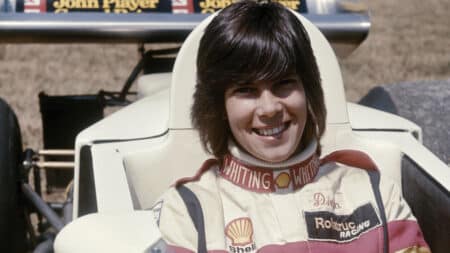
Divina Galica in ShellSport Whiting Surtees at Brands Hatch in 1976

Divina Galica in ShellSport Whiting Surtees at Brands Hatch in 1976

Ercole Colombo/Getty Images

And now let me tell you a touching little story. Divina Galica finished sixth in the Shellsport International championship of 1977, in an ex-works Surtees TS19 entered and run by Nick and Charlie Whiting – yes, the very same Charlie Whiting who would go on to join the Brabham F1 team as chief mechanic then would become F1 technical delegate and F1 race director for the FIA. On the 1977 August bank holiday weekend on which McGuire met his maker, Galica qualified second and finished third, beaten by Emilio de Villota in an ex-works McLaren M23, who won, and Tony Trimmer in another ex-works Surtees TS19, who was second.

In 2019 and 2020 I was the comms and PR director for W Series, that much missed free-to-enter single-seater series for female drivers only. The last round of W Series’ inaugural season, 2019, took place at Brands Hatch, and on the eve of the race, together with Divina, whom I had engaged that year to coach our drivers, I walked the track. As we approached Stirlings, the fast 90-degree left-hander that funnels the cars to Clearways, Clark Curve, and the end of that majestic lap, she abruptly stopped. “This is where Brian breathed his last,” she said, almost inaudibly.

It was a balmy evening, and she and I were entirely alone. Suddenly, she was overcome. She did not cry, but she welled up. For a time she could not speak. I am extremely fond of her, so I gave her a hug, then, after a while, I dared to ask her, “What was he like?”

She did not reply immediately, then she spoke at some length. I did not record what she said – that would have been inappropriate given the intimacy of the circumstances – but I wrote in my notebook what I had remembered of it as soon as we returned to the paddock. Divina can be a lyrical storyteller when the mood takes her, and here is what I wrote.

From the archive

“He was a nice guy. He was pretty quick, too. He raced hard, he lived hard, and he played hard. He didn’t get the breaks, but he absolutely belonged in the messy, noisy, oil-stained world of 1970s British motor racing, where deals were done on handshakes, where cars were fixed with ingenuity and optimism, and where the line between triumph and disaster was often measured in inches. In the end it was measured in inches for him, certainly. He was part of the fabric of our world, and, when he was gone, that fabric was subtly but permanently altered. I realise, now, standing here at Stirlings, that I haven’t thought of him for years. Perhaps I should have done, but it was a long time ago. Anyway, I’m thinking of him now.”

Eighty years on from McGuire’s birth, it is worth asking ourselves why we take time to remember some racers but not others. Success, of course, is the most obvious answer, but it is not the only one. Context matters; timing matters; and survival matters. Brian McGuire did not survive long enough to become a champion, a regular winner, or even a fixture. But he survived long enough to matter, and long enough to leave a mark, however faint it may seem from the distance of 48 years. After all, he was Alan Jones’ best mate; he had the gumption to cross hemispheres in pursuit of a dream; and he scored the first ever Williams win.

In the end, perhaps that is the most fitting way to mark what should have been his 80th birthday: not with exaggerated claims or sentimental excess, but with recognition; recognition that motor sport is richer for having had this hardy Aussie in it, however briefly; recognition that behind every F1 world champion, from Giuseppe Farina to Lando Norris, there was and is a posse of talented but rarely remembered contemporaries whose stories are no less compelling for the absence of silverware; and recognition that ghosts are only ghosts if we let them fade.

So, today, spare a thought for Brian McGuire. Picture him in an Earl’s Court pub with Alan Jones, two young Aussies plotting their futures over pints of Watney’s Red Barrel and improbable optimism. Picture him at Thruxton in 1976, climbing from that Williams FW04 with a grin that suggested that he knew, on some level, that he had done something special. Picture him at Brands Hatch in 1977, on the day he died, doing what he loved, and doing it as hard and as well as he knew how. He should have turned 80 three days ago. He should have had more time. He should have had more chances. But he had enough, just enough, to ensure that his name, whispered now rather than shouted, still resonates. RIP Brian McGuire.