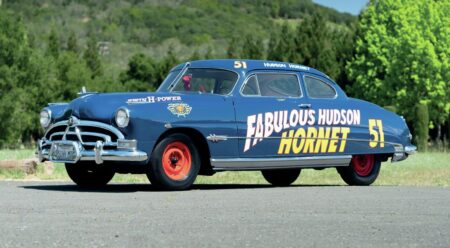
Doc Hudson from Disney's Cars film is one of the most loved characters in animation – but he's based on a real NASCAR machine. Here's the story of the actual Hudson Hornet, and how it inspired the movie.
The 'Fabulous' Hudson Hornet – the NASCAR standard for three years in a row
Lightning McQueen may have popped up at the 2026 Monza GP, but he’s just one of many legends in the hugely popular Cars franchise. For one, Doc Hudson has more than a couple of Piston Cups in his garage. Voiced by Paul Newman in Disney/Pixar’s 2006 hit, the gruff old doctor of Radiator Springs turned out to be a former racing champion in disguise – and the character wasn’t invented from scratch.
Doc Hudson is actually a tribute to a dominant race car: the ‘Fabulous’ Hudson Hornet, which spent the ‘50s dominating the NASCAR circuit.
The real Hudson Hornet
Hudson, a mid-level car manufacturer based in Michigan, first produced the Hornet in 1951 as a family saloon car with a stylish bent.
Herb Thomas inspects the damage at a 1954 race
Getty Images
It did this with a ‘step-down’ chassis design which ran closer than most cars to the ground, giving it good handling through a low centre of gravity, as well as a sleek appearance. The ‘step-down’ approach was first used with its 1948 Commodore model.
The Hudson Hornet is known for its role in Disney film Cars but the story that inspired it is just as compelling: here’s how Herb Thomas raced the legendary car to two NASCAR titles and missed out on a third in controversial circumstances
By
Paul Fearnley
These innovations piqued the interest of ‘50s NASCAR driver Marshall Teague, the so-called ‘King of the Beach’ due to his Daytona dominance – it was then run on the sand of the Florida seafront prior to the construction of the famous permanent circuit. It was he who first persuaded Hudson to get involved in motor sport.
The Florida native turned up at Hudson’s Michigan factory unannounced prior to the 1951 season and told the firm racing could be a key part of its marketing strategy – and he was right.
The potent pairing won on debut at the 1951 Daytona 500, with Teague claiming 78 NASCAR races out of a possible 149 across four years.
With some remarking that the Hornet looked like an ‘upturned bathtub’, Teague – along with his crew chief Smokey Yunick – had spotted that the car had all the technical attributes to make it in NASCAR.
The sport was then mainly run on dirt ovals, and the strong torque of the 5-litre straight-six engine gave it an advantage over the opposition, despite having less grunt than most at 210bhp.
Teague (left) and Thomas brandish their winnings (and Hornets)
Getty Images
The Hornet’s low-slung design and favourably low-centre of gravity combined with its accurate centre-point steering to make it a very driveable race car.
Catching on to the positive press provided by on-track success, Hudson began painting the prefix ‘Fabulous’ on the side of its cars, and used it in advertising too.
Teague would win five top-level NASCAR cup races in 1951, but it was his competitor-turned-team-mate Herb Thomas who sealed the Hudson Hornet into legend. Initially starting the 1951 NASCAR Cup series with a Plymouth, a mid-season switch to a Hudson Hornet with Teague’s team brought five wins and the championship.
After Tim Flock claimed the 1952 championship driving a Hornet too, in ‘53 Thomas used his again to dominate the series, winning 12 races as he became the first double Cup champion.
Though finishing runner-up to Lee Petty in 1954, Thomas had the most wins of that season with 11.
Bigger firms like Ford and Chrysler reasserted their supremacy from 1955 onwards, but the Fabulous Hudson Hornet had already made its mark.
Thomas the leader of the NASCAR pack in a Hudson Hornet – a common sight in the early ’50s
Getty Images
Doc Hudson from Cars
In Cars, Paul Newman’s Doc Hudson character resembles the Hudson Hornet and is based on both Teague and Thomas. The car has the No. 51 painted on its side – presumably signifying the actual machine’s first year of competition.
Marshall Teague is famous for his ‘Fabulous Hudson Hornet’ that put NASCAR on the map and on a commercial footing in the early 1950s. But he was killed in a…
By
Paul Fearnley
During the Cars film, main character Lightning McQueen, played by Owen Wilson, ends up stranded in the Route 66 town of Radiator Springs, en route to championship-deciding race for the ‘Piston Cup’ – i.e. the NASCAR Cup series.
The Paul Newman’s Doc Hudson character is both the judge and doctor of the town, and sentences McQueen to community service after damaging a main road, apparently prejudiced against him for being a racing car.
However, it ultimately turns out that Doc himself is a former champion. Challenging McQueen to a dirt track oval race to secure his freedom from Radiator Springs, Doc’s prowess on the loose stuff soon becomes apparent as McQueen spins off.
It emerges that Doc himself – as the almighty Hudson Hornet – has several Piston Cups to his name. In the end, it all works out as Doc becomes McQueen’s crew chief during the crunch finale.
Doc Hudson character in Cars film
During the race, an act of selflessness by McQueen to help competitor Strip ‘The King’ Weathers – i.e. NASCAR legend Richard Petty – hands the championship to rival Chick Hicks.
However, the moral prevails that it’s not all about winning, and McQueen returns to Radiator Springs to establish a race headquarters there and revive the town.
Though the ‘Fabulous’ car became famous all over again, it was its victorious dirt days in NASCAR’s top championship that first put it on top.