“It doesn’t give much warning of when it’s about to swap ends, but it’s brilliant fun.”
This will be sweet music to RT1’s creator, Ron Tauranac. The Australian is one of the greatest commercial race-car designers. During his 10 years with Brabham, the company built 600 customer cars. They were usually simple, rugged, a joy to drive – and competitive. While Colin Chapman was chasing the next big thing, Tauranac’s designs were subtly evolving. And unlike Chapman, Tauranac was responsible for every nut and bolt on his cars never more so than on the RT1, the car that marked the second phase of his career.
He left the Bernie Ecclestone-owned, F1-centric Brabham in 1972 and, after short spells with Frank Williams and Trojan, contemplated retirement. And then set up shop at Snelgar Road, Woking, during the winter of 1974. Ralt was to be revived.
An amalgam of Ron’s and his brother’s (Austin Lewis) initials, the first Ralts were built in Sydney during the 1950s: two single-seaters for Ron, and a sports car for Austin. Ron laid down a batch of the second single-seater and planned to sell them, but was whisked away to England by Jack Brabham before the project could be finished.
So Ralt lay dormant – until March 31, 1975, which is when Larry Perkins lined up his RT1 at Thruxton for the first round of the BP Super Visco F3 series. He might have won, too, but for a moment’s inattention and the resultant off. He secured the European F3 title, though, with victories at Monza and Croix-en-Temois.
Ten RT1s were built (the early cars were constructed by Gomm) that first year: four F3s, three Formula Atlantics and three F2s, all based around the same tub: adaptability was a Tauranac watchword. Thirty were built in 1976, and 41 in ’77, one of which went to Italy for Nelson Piquet Soutomaior.

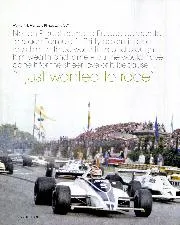
Chaos at Brands Hatch in 1978 – Piquet is on the left
Getty Images
The reigning Brazilian Super Vee champion had begun the European F3 series disastrously, in a March, and so swapped allegiances. This brought him an upturn in results, winning at Jarama and Kassel-Calden (a German airfield). The following year, he decided, he would focus on Britain. The subsequent campaign would change the face of British F3 for ever.
A brand-new RT1 was ordered, but its build ran late, and the early season proved fraught, as Derek Warwick‘s year-old RT1 won five of the first six races. Piquet, however, had time on his side. Warwick was competing while holding down a full-time job at his family’s trailer business, whereas Piquet had no such distraction and, along with mechanic-cum-manager, Australian Greg ‘Peewee’ Siddle, set about turning the tables.
“We were the first to use aircraft nuts and bolts, which are lighter”
“The main thing was the amount of testing we did,” says Siddle. “We had a spare car by May, and we tested them continually. We really got to know the car.” And maximise it.
The formula’s strict regulations, the cars’ straightforward designs, and Tauranac’s desire not to be seen to be favouring one particular team, meant performance gains would be fractional, but precious and crucial. This RT1 became the best, most important, of the 150-or-so built because of a host of detail changes.
“We were critical on weight,” continues Siddle. “There’s not much you can do when the monocoque is aluminium and the wishbones are steel, but we were the first to use aircraft nuts and bolts, which are lighter. We had lighter fibreglass bodywork made, too. And what weight we had, we put as low and as central as possible: we resited the battery and extinguisher, and lowered the headrest. We were able to go a bit lighter in the duff, too.