Roberto Moreno: The worst car I ever drove – AGS JH21C

That this talented Brazilian should end up driving so many truly Dreadful Formula 1 cars remains a mystery. Gary Watkins asks him how it feels to be spoiled for quantity, if not quality

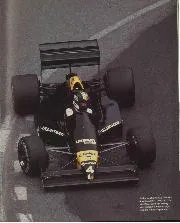
Roberto Moreno from Brazil driving the #14 Team El Charro AGS (Automobiles Gonfaronnaises Sportives) AGS JH22 Cosworth V8 during the Formula One Foster's Australian Grand Prix on 15th November 1987 on the Adelaide Street Circuit

Moreno on AGS: great team, the car less so

Getty Images

July 7, 2014

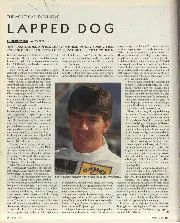
A couple of years ago Roberto Moreno was asked to be the subject of a Worst Car I Ever Drove for Motor Sport. He refused. The reason? He wasn’t sure if he had yet driven his worst racing car. For a driver known for his eternal optimism, that was a strangely pessimistic response. After all, the ChampCar star of today has driven for almost a full complement of back-of-the-grid Formula 1 teams through the late 1980s and early ’90s. Roberto can choose his worst from AGS, Coloni, EuroBrun, Minardi, Andrea Moda and Forti. Impressive, in a funny sort of way. And because he also raced a Benetton, and tested for Williams and Ferrari, he knew exactly how bad these machines were.

Suggest at your peril, though, that the Andrea Moda of 1992 might be his least favourite grand prix machine. He describes the Judd V10-powered S921 as “a very good car”. The Nick Wirth design, he says, had “fantastic potential”. It was just that the team, owned by Italian shoe millionaire Andrea Sassetti, wasn’t able to exploit it.

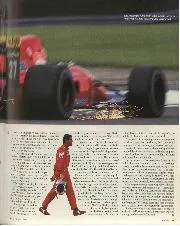
SUZUKA, JAPAN - NOVEMBER 01- Roberto Moreno, AGS JH22 Ford during the Japanese GP at Suzuka on November 01, 1987 in Suzuka, Japan. (Photo by LAT Images)

The Brazilian retired from his first effort with the car in Japan

Getty Images

“Nick came up with a very good chassis, but the team was doing everything with no money at all,” recalls Moreno.

“By Monte Carlo [five races into the life of the S921], the thing was falling apart. They never bought new bits for it.”

Related article

Moreno hauled the Andrea Moda onto the grid just once before the team’s nadir at Spa-Francorchamps. Not only did both he and number two driver Perry McCarthy have their steering momentarily seize on them through Eau Rouge, but Sassetti was arrested in the paddock on forgery charges. The latter incident was deemed to have brought F1 into disrepute and the team was politely asked not to show up again.

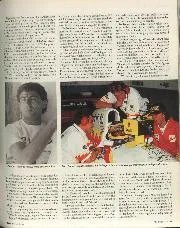
The Brazilian doesn’t like talking about his time with Andrea Moda, but he does have admiration for the team that supplied him with the worst car of his career. The 1987 AGS might have been “like a bus”, but he still marvels at the enthusiasm of the tiny squad from the South of France. “Those guys were so keen,” remembers the veteran of 41 GP starts. “They achieved far more than they should have done with the equipment available to them.”

That equipment had its roots in an old Renault chassis. Legend has it that when the moderately-successful Formula 2 and 3000 team purchased a truck from Renault’s defunct F1 operation, it arrived with a couple of old tubs stowed in the back. That’s not quite true, according to the AGS team manager of the time. “We had arranged to buy a truck and some gearboxes from Renault and they gave us the rear suspension for free,” says Philippe Leloup. “At that time, Ligier wanted some parts from the programme as well. But the Renault people decided they’d rather give stuff to us than sell it to Ligier.”

Roberto Moreno from Brazil driving the #14 Team El Charro AGS (Automobiles Gonfaronnaises Sportives) AGS JH22 Cosworth V8 during the Formula One Foster's Australian Grand Prix on 15th November 1987 on the Adelaide Street Circuit in Adelaide, Australia

Moreno says he could hear the chassis flexing when the car was raised for pitstops

Getty Images

The AGS-Motori Moderni JH21C that contested the final two European races of 1986, and the following year’s Cosworth-engined JH22, were built around the same monocoque as Renault’s final F1 contender, the 1985 RE60.

“They were new chassis, but built to the Renault design with only small modifications,” explains Leloup.

From the archive

Needless to say, the first AGS wasn’t a particularly effective device. Frenchman Pascal Fabre was habitually the final qualifier in the lone AG S-Ford in a season with exactly a grid’s worth of 26 cars. The arrival of more entries over the final third of the season gave the team a problem. Its solution was to ring Moreno.

“They called me before Monza because they were worried they wouldn’t get on the grid,” says Moreno, a factory Rak driver in European Formula 2 that year. “I told them I wanted to finish my championship first, but that in the mean time I’d do some testing so long as I was paid.

“We went to Paul Ricard and the car was terrible. The chassis was supposed to be really stiff, but it clearly wasn’t. When they used the quick-lift jack, you could hear the carbon-fibre creaking. The chassis was so soft that it didn’t matter what we did with the anti-roll bars, so I decided to set the car up in a different way and we managed to improve it by three-and-a-half seconds a lap. They took my settings and put them on Fabre’s chassis in Spain, and he got on the grid for the first time in a couple of races.” More than five years after failing to qualify a Lotus at the Dutch Grand Prix, Moreno made a belated F1 debut in Japan. Two weeks later, on the Adelaide street circuit, he scored a maiden world championship point for both himself and his team in what was a race of attrition. The AGS crossed the line seventh, and Moreno was on a plane by the time Ayrton Senna‘s Lotus was disqualified from second for running illegal brake ducts.

Roberto Moreno (BRA) AGS Cosworth JH22 - 6th place Australian Grand Prix, Adelaide, 15 November 1987 (Photo by Sutton Images)

Following a disqualification for Ayrton Senna in Adelaide, AGS and Moreno scored their first point together

Getty Images

Roberto thought he had a full-time drive for the the following season, but when AGS was forced to abandon plans to run two cars, it opted to go with team old boy Philippe Streiff. Not that Moreno has any bad memories of his short spell with AGS, unlike his year with a certain Italian team five years later. “They tried so hard,” he says. “If you’d given them a car as good as the Andrea Moda, they would have probably won races.” Told you he was optimistic.

Worst car I ever drove: Stars look back on racing nightmares