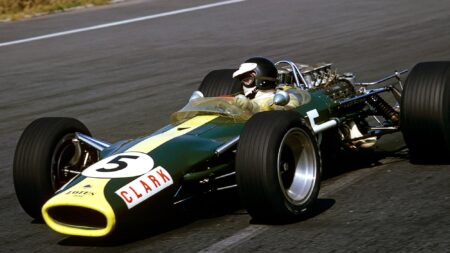
Second lap. A bit drier. With 95bhp, acceleration is strong but manageable — the car weighs just 770lbs — with the little Anglia engine pulling hard and clean from 5000-8000rpm, holding a long emotive bark down the Lavant straight. Brake into Woodcote and through, watching the delicate suspension work, tyres maintaining flat contact with the tarmac, even under hard cornering. Over the top of that little screen, a view unchanged in 40 years.
The lines are drying. Pushing harder now, simply amazed; strap on a modern body and I doubt a driver of middling ability would guess he was pedalling a 40-year-old machine. If Caterham were to build a mid-engined road car, it would feel like this. The steering is light and yet delivers superb feedback. Going around Lavant quicker, the 18 is terrifically balanced, neutral, hinting at a drift. Even the drum brakes pull the car up in a straight line. The only thing that gives the game away at all is the gearbox — rules meant that it had to be sourced from a production car, and Dauphine gearbox technology could hardly be expected to keep pace with the rest of this car. It’s positive enough between gears, but the ratios, especially the yawning gap between third and second, make life difficult for the little Anglia powerplant.
And then the other inevitable sensation, an electric pulse of fear. It was just a little waggle, a little warning that neutrality could turn to snapping oversteer a little quicker than you might expect. Through the left at St Mary’s with that unhelpful camber. And you’ve never really forgotten that lightness and weight distribution came first, 40 years ago, with driver safety pretty secondary to the plot You remember where your feet are, the consequences of going in nose first. Obvious, really, but worth reflecting upon. Back in the pits. There’ll be other laps.
Mike Costin is leaning against the pitlane wall when I emerge from the car. These chaps are not particularly nostalgic — they’ve lived a pragmatic life that was always about looking forward to the next innovation — but Costin has a big smile for the 18. And he allows that Cosworth was a very different thing in the ’60s. He won’t say it was a better time to be an engineer, but his expression says otherwise. He remembers when working at Cosworth meant doing it all, including the testing. “We had to test at racing speed,” says Costin, brightening at the memory. “It was the only way you’d find things out.” He stares out at the start/finish line: “You’d be in second at seven or eight thousand here, up into third and into Madgwick at something like 8000rpm.” Seconds later, he straps himself into the Lotus, goes out to check his own figures. He’s back in after a couple of laps, disappointed the noise restrictors have robbed the 18 of its full complement of power and voice.
Duckworth has a go, too. He enjoys the experience, remembering a little about how things were. Like Costin, Duckworth wonders whether a large organisation like Ford will be able to maintain the Cosworth way, says he doesn’t know the answer. “It was a different culture at Cosworth, a culture that demanded you don’t do the calculations until you understand what the problem is,” says Duckworth. “Mike and I were always concerned with getting it right the first time and avoiding development costs. We prided ourselves on our engineering and reckoned we could do for one bob what any bloody fool could do for a pound.” Mike Costin adds: “It’s not a job, it’s a commitment. You can only achieve that with a relatively small committed organisation.



 Great Read


