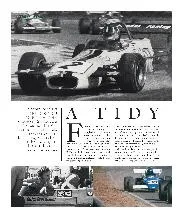
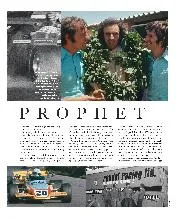
Gentle, quietly-spoken and popular with team colleagues, Tom Pryce nevertheless had star quality on track — a quality that never got the chance to truly shine
If you stroll down one particular street in Fulham, there is an antique shop which you might walk past with only a casual glance. Unless, that is, you are a Grand Prix racing fanatic. If you are, then the legend above the door will catapult your mind back to the mid-1970s and Britain’s lost Grand Prix generation, for the sign reads “Pryce and Brise”.
The shop is owned and run by Nella Pryce and Janet Brise, both widowed in their twenties when their husbands Tom and Tony were killed in 1977 and 1975 respectively. Along with Roger Williamson, who was killed when his works March crashed during the 1973 Dutch Grand Prix at Zandvoort, they were brilliantly talented young men whose initial promise in Formula One never came anywhere close to blossoming in full.
Tony, of course, died in the air crash which claimed Graham Hill and four other members of the Embassy Hill Grand Prix team in November ’75, but Tom raced through 1976 and into 1977 before a banal, bizarre accident in the South African Grand Prix cut short a career which, at the very least, should have taken him to the Grand Prix winners’ circle.
Pryce in the pits at Monaco, 1976
Grand Prix Photo
As I write these words, it is a month or so short of ten years since Jansen van Vuuren, a 19-year old reservations clerk who worked at Johannesburg’s Jan Smuts airport, leapt over the pit barrier in his capacity as an enthusiastic fire marshal on lap 23 of the South African Grand Prix. Sprinting across the track, just beyond a blind brow, his intention was to reach Renzo Zorzi‘s Shadow DN8 which had rolled to a halt on the opposite side of the circuit, smoking merrily with a minor electrical fire.
As everybody knows, van Vuuren never made it to the other side of the track. His conscientious, yet misguided, enthusiasm cost him his life as he was collected by Pryce’s sister Shadow, the Welshman working his way steadily through the field after troubles (we will never know what) dropped him almost to the tail of the field on the opening lap. The extinguisher carried by the marshal caught Tom full in the face at 170 mph and he too died instantly.
Pryce’s wayward Shadow continued running in a straight line all the way down to Crowthorne Corner where it tangled with the innocent Jacques Laffite‘s Ligier, both cars ending up in a heap amongst the catch fencing.
On the anniversary of Tom Pryce’s death in the 1977 South African GP, Matt Bishop remembers the other man killed that day: Frederik Jansen van Vuuren, as well as his fellow F1 marshals who lost their lives in the service of the sport they loved
By
Matt Bishop
I was standing on the bank at Crowthorne, reporting the race for Motoring News, and can honestly say it was the lowest moment of my career as an F1 journalist. Not simply through the shock of the moment, but because Pryce was one of the closest genuine friends I had made during my time in the business. Therefore, if this memoir seems mildly self-indulgent, I make no apology. . .
Fiercely proud of his Welsh origins, Thomas Maldwyn Pryce was born in Ruthin, Clywd, in 1947. Even-tempered, good lurking and mild-mannered, his gentle personality belied his talent behind the wheel of a racing car. Modest almost to a fault — he once told me, “I really wanted to become a pilot, but I don’t really think I was bright enough” —by the end of his career he developed a keen perception of his own worth as a Grand Prix driver. He may have been an innocent when it came to commercial wheeling-and-dealing, but, inwardly, he knew he could race with the best of them.
For Tom Pryce, it was a long, tricky road to Formula 1 prominence, strewn with problems and pitfalls. Whilst studying at agricultural college in Wales he eked out his pennies to pay for a course at Motor Racing Stables, training both at Brands Hatch and Silverstone. He could only afford to participate in one of their private races a month; in far off 1969 they cost thirty-five quid a time!
But Tom’s tenacity got him to the final round of the Daily Express Crusader contest, first prize in which was a brand new Formula Ford Lola T200. The destiny of that prize settled on the outcome of a single race: Tom won it easily, securing his immediate racing future.
He moved down to work at Brands Hatch as an MRS mechanic while he was racing the Lola, a change of environment he initially hated. Tom loved his native land with passion, his natural fluency in the Welsh tongue invariably coming to the surface when chatting with his father, one of his greatest fans and a stalwart supporter of his racing ambitions from day one.
That Lola served him well throughout 1970, although its short-wheelbase configuration made it twitchy to drive and taxed Tom’s car control quite dramatically. He won quite a few races, but no championships, before switching to Formula Super Vee and F100 sports cars in 1971. This proved something of a backwater for Tom’s career, but thanks to the faith of Royale boss Bob King, he got into Formula 3 the following year and really began making his mark.
Pryce made a splash when he moved up to F3 in 1972
Grand Prix Photo
With the neat little RP11, he walked away with the Race of Champions supporting race, beating James Hunt, Colin Vandervell and all the other F3 pace-setters of the time. He looked set to repeat this runaway victory at the Good Friday Oulton Park meeting, but spun away the lead while well ahead. Nonetheless, it seemed as though he was set fair to make a considerable mark on the F3 scene, but Tom’s whole programme came to a shuddering halt during the rain-soaked Monaco F3 meeting.
“I stopped with engine trouble on the left-hander going into Casino Square”, he told me at the time, “and I was standing there fiddling with the engine when I looked up and saw Peter Lamplough coming straight for me. I absolutely froze on the spot and the next thing I knew was that they were picking me out of the shop front into which my car had been hurled by the impact. The net result of that little excursion was a broken leg. . .”
The writer well remembers Bob King’s sense of despair as the wreckage of Tom’s Royale was loaded back into the transporter amidst the cramped confines of the saturated Monaco F3 paddock. His driver injured, the car wrecked, the budget exhausted, there seemed no way in which he could continue. Yet, in a display of typical motor racing resilience, not only was the F3 car back on pole position five weeks later, but Pryce was strapped in its cockpit.
However, his F3 return was fleeting, so he eked out the balance of the 1972 season dabbling in Super Vee. He won just about every race he contested, but wasn’t making much firm career progress. This changed in 1973 when he first had a crack at Formula Atlantic and finally landed a plum drive in the Metal Rondel F2 team, thanks to the patronage of Leeds businessman and amateur racer Chris Meek.
Run by future McLaren International commercial director Ron Dennis, the Motul Rondel outfit was one of the front-running prestige F2 teams of its time. Pryce ran a total of eight races in the Motul M1, the high spot of his year being at the Norisring where he led comfortably until the brakes gave trouble, dropping him back to an eventual second behind team-mate Tim Schenken.
Rondel planned an F1 challenge with Schenken for 1974, but when Motul switched its sponsorship to BRM, the Ray Jessop designed car was left in a half-completed state. It seemed unlikely that it would ever race, until Tony Vlassopulo, who had been involved as one of Rondel’s prime backers right from the start in 1971, put up some money for the car to be completed and christened the Token.
Meek supplied a Cosworth DFV and Tom found himself nominated to drive the smart Ray Jessop-designed car at the International Trophy meeting. It failed to finish, but the team was sufficiently encouraged by Pryce’s showing to enter the Belgian Grand Prix at Nivelles. Tom qualified just short of mid-grid for his first Championship race, but again retired.
Pryce’s Token-Ford failed to finish at Silverstone in the 1974 International Trophy
Grand Prix Photo
Then followed a major disappointment which, ironically, turned into the making of Tom as a Grand Prix star. The Token entry for Monaco was turned down, so Pryce was entered in the supporting F3 classic in one of the Ippokampos team March 743s.
“I must admit that I had grave doubts as to whether I was doing the right thing at the time,” he later reflected, “because it was pointed out to me that I’d really no alternative but to win. If I didn’t, I felt that it might jeopardise our chances of getting fresh backing for the Token. That was all I had in my mind at the time.”
In the event, Tom won the race commandingly. And then stood back, bewildered, as the offers came cascading in from three other F1 teams. Hesketh, Williams and Shadow were all anxious to secure his services and, after careful consideration, he opted for Shadow.
Pryce was eighth in the 1974 British Grand Prix: his first classified finish for Shadow
Grand Prix Photo
The American-financed, British-based team had lost its number one driver, Peter Revson, in a testing accident at Kyalami earlier in the year, and Brian Redman had been “filling-in” ever since. But the popular Lancastrian intensely disliked all the “hype” surrounding F1 and wanted out. Pryce’s availability came at just the right moment . . .
Tom slipped easily into the friendly surroundings of the Northampton-based outfit. Team manager Alan Rees had a gut feeling that Tom’s was a rare natural talent which only needed taming slightly to produce Grand Prix success.
A fellow Welshman from Monmouth, Rees tutored him diligently, sometimes sternly, trying to restrain Tom’s oversteering, opposite-lock enthusiasm. At Paul Ricard, during practice for the 1975 French Grand Prix, Rees threatened to call him in if his left-hand wheels an much as brushed the kerbing on the right-hander before the pits. “But it feels so slow”, Tom protested. The time sheets confirmed that smoother was even quicker . . .
Victory at Brands Hatch in the 1975 Race of Champions
Grand Prix Photo
The Tony Southgate-designed Shadow DN5, introduced at the start of the 1975 season, was a fine-handling piece of equipment. Tom’s team-mate Jean-Pierre Jarier had the Brazilian GP at Interlagos in the bag when a metering unit malfunction stopped him in his tracks whilst nursing a half minute lead. Tom followed on by winning the non-title Brands Hatch Race of Champions after a drive which underlined his fast maturing talent, and later qualified on pole for the British GP at Silverstone, the last pre-Woodcote chicane F1 race round the Northampton circuit.
He led briefly at Silverstone, but sheer inexperience saw him slide off in rain shower at Becketts — long before the torrential downpour that ended the race prematurely.
But a fine fourth place at Nürburgring, bathed in petrol from a leaking tank, followed by third in the saturated half-points Austrian race, did a lot to boost his reputation outside the Shadow ranks.
Within the team itself, his gentle character and malice-free sense of humour helped Tom forge a bond with his mechanics which went deeper than a mere working relationship. By the end of 1976, Tom had become “their” driver, more like a brother than anything else.
In fact, perhaps unconsciously, the whole Shadow effort began to polarise round the quite-spoken Welshman and the mood towards Jarier became one of cautious resentment. The Frenchman had hardly endeared himself to his mechanics after losing the lead of the non-title Swiss GP at Dijon. Jean-Pierre spent most of the race charging over the infield kerbs with mechanically insensitive abandon — and then announced that “the Shadow team couldn’t prepare a bicycle . . .” after the transmission broke. Not too tactful . . .
At the end of the 1975 season, Shadow lost its sponsorship from Universal Oil Products (UOP), so Pryce and Jarier had to soldier on with the DN5s for most of the following year.
Southgate finished drawing the new DN8 in the early months of ’76, but it was not until Zandvoort, on August Bank Holiday Sunday, that the first of the new cars was ready.
Pryce began 1976 with the DN5 again — here at the Spanish GP
Grand Prix Photo
Pryce, by now firmly established as team leader, debuted the car, qualifying third and finishing fourth despite an engine pick-up problem. At last it seemed as though things might be about to improve, and he rounded off the season running second in Japan (closing on Hunt) when the engine failed.
By now, Tom’s loyalty to Rees and Shadow was getting in the way of hard racing judgement. At Monza, 1976, I was approached by Colin Chapman and Peter Warr to sound out Pryce about switching to Lotus alongside Mario Andretti in 1977.
Clearly, this would have been the right thing to do in the light of subsequent history but, of course, it is easy to make such judgement with hindsight. The facts of the matter are that Lotus was still pulling itself out of the mid-seventies mire at the time, and only a few people on the inside of the sport knew about the ground effect magic Chapman had up his sleeve . . .
On the pitwall at Nivelles in 1974 with (left to right) Jacky Ickx, Tim Schenken, Rikky von Opel, Tom Pryce and John Watson
Grand Prix Photo
On balance, Tom seemed cautious about going to Lotus. This reluctance stemmed from a mixture of loyalty to Rees and the lads, plus Nella’s obvious anxiety about his driving a Lotus. She had somehow latched on to the idea that Chapman still produced rather frail racing cars. I think I managed to convince them both that this was no longer the case but, even so, in the end he chose to stay where he was, where he felt comfortable.
Rightly or wrongly, Tom felt a sense of obligation to the people who had given him his big chance, even though many people believed he was being too generous. It should be recalled that when the chance came up to do a deal with Lotus to swap Tom for Ronnie Peterson in the early months of 1975, Shadow was ready to give up its new boy on the spot. Perhaps, on reflection, it is a shame he didn’t go then . . .
1977 kicked off with Shadow using the DN8 yet again, now enjoying sponsorship from wealthy Italian Franco Ambrosio, whose influence brought the inexperienced Renzo Zorzi into the team as number two driver. Over the winter, changes to the DN8 had increased its weight slightly, but it was still quite a good handling car and Tom was up to second at Interlagos, chasing Reutemann’s winning Ferrari T2, when engine failure intervened yet again.
Then came Kyalami and one final demonstration of that in-bred talent which so frequently had been hampered by less-than-competitive equipment. It poured with rain during first qualifying, but Tom wheeled that Shadow round a full second quicker than anything out on the track, revs surging with wheelspin over the puddles. The DN8 was nowhere in the dry, but the weather had intervened to allow Pryce’s star quality one final chance to go on display.
Pryce at Kyalami, 1977
Grand Prix Photo
The night prior to the Grand Prix I was chatting enthusiastically about Tom with fellow scribe Maurice Hamilton, now motor racing correspondent of The Independent, but then a novice freelance just starting to make his name. He too was a Pryce fan, having admired him for years from the spectator enclosures, so I promised I would introduce Maurice to him after the race.
Of course, that introduction was never made. The stunning disbelief felt by us both numbed our senses for days. It was a stupid, unnecessary accident from which, to this day, nobody has learned anything; drivers and marshals still cross circuits during qualifying sessions and races. Inevitably, such a tragedy will be repeated.
Tom Pryce had more obvious talent than several youngsters who subsequently scaled GP-winning heights, of that there is no doubt in my mind. His driving mirrored his own personality — uncomplicated and enthusiastic, spiced with star quality.
For those of us who knew him really well, the business of motor racing would never be quite the same again. For me, March 5 1977 was the day the circus left town.