Great Read
Archive
Lunch with… John Webb
Having begun as a motorcycle grass track as far back as the 1920s, Brands Hatch has been a racing circuit for over 60 years. For more than half that time…


Danny Ongais at Brands Hatch, Indycar rocked Britain's two top circuits
Getty Images
One miserable weekend in 1978, a new chapter in motor sport opened at Silverstone. Eight days later, at a Brands Hatch bathed in autumn sunshine, it closed. Short. But sweet. For contained within that single chapter was a spellbinding story of dauntless heroes and magnificent machinery battling against adversity.
Sadly, that wasn’t enough. The United States Auto Club’s British two-race tour was a success for spectators, participants and organisers, despite the weather delaying the Silverstone race by a day. It was a victory, therefore, for everyone who read above the bottom line. But the men who provided the wherewithal to make these events happen could see only that the bottom line sucked. Big time. John Webb, managing director of Brands Hatch at the time, and the man behind the Indycars’ incredible British adventure, is philosophical about it to this day:
“I think we needed 20,000 people at each circuit to break even. At Silverstone, the rain obviously affected attendance, which I think was in the region of 10,000; Brands was rather better at around 15,000. But we ended up with a £250,000 loss, and that alone determined that we couldn’t afford to do it again. It must have cost us about £500,000. To put that into context, our group was probably not turning over more than 12m a year. Grovewood, our parent company, had the attitude that, ‘Whatever you make, we will put back’, and they never took a penny out of it. So you have to see their reluctance to be involved further against a background in which we lost what would have been ploughed back into the business.

Jet dryers deployed at Silverstone, to not much avail
Getty Images
“Grovewood allowed me to conduct the experiment but they were less than amused that the entire profits of that year’s British Grand Prix had been wiped out by it. They took a benevolent attitude but the question never arose as to whether we’d try again. In 1978, £250,000 was a fortune; you could buy complete circuits for that money.”
The end-of-September weather at a windswept former airfield in Northants hardly helped Webb’s cause. Back then Indycars didn’t race in the rain; their championship calendar consisted mainly of ovals and superspeedways, which were lethal when wet. Guessing correctly that the elements would prove unfavourable, Webb had hired from Santa Pod drag strip a curious if impressive device for drying the track. It consisted of a truck bearing two Rolls-Royce Derwent engines (as used in the Gloster Meteor); revved to 11,000rpm, they did their job, but couldn’t stop the rain from falling. Brian Jones, commentator at Brands Hatch since 1973, attended the Silverstone event, too.
“It was a valiant effort to put the show on,” he says. “But it was like trying to sweep Wembley free of snow in front of empty grandstands. So bearing in mind the small number of spectators at Silverstone, a rapid decision was made at Brands Hatch to switch the race from the Grand Prix circuit to the Club circuit. I’ve always felt it says something of John Webb’s nature that he chose to commemorate losing a quarter of a million pounds by renaming the Club circuit the Indy circuit”
Ah yes, but John was – and remains – a true enthusiast. Hell, that was how he had the idea in the first place.

Brands Hatch’s first Indycar race gets underway
Getty Images
“During the stewardship of Angela [his wife] and myself at Brands Hatch we were always looking for something new,” he says. “We found ourselves at a Can-Am race at Mid-Ohio in August ’76 and ran into a guy called Dick King, then president of USAC. We asked him what the chances were of bringing Indycars to England, and instead of throwing it out he considered it seriously and investigated it. Money was a key factor and very early in our computations we realised that one race meeting couldn’t recover the costs of bringing the cars over and pay prize money. So we got together with Silverstone and suggested that either they came in with us or we would hire the circuit from them. And that’s what we did. It sounds silly these days but we paid them £5000 for use of the circuit.”
The plan’s big disadvantage, though, was that this was pre-satellite television and so British motor sport enthusiasts were largely ignorant of Indycars.
“Being enthusiasts ourselves we overestimated the knowledge and acceptance of the British public,” admits Webb. “Our mistake was in assuming everyone automatically knew what an Indycar was and what the racing was like. We had the advantage of the British GP just 10 weeks earlier, so we had a large captive audience to promote to, and still we didn’t get the right reaction.”
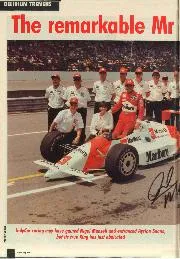
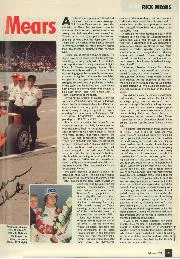
Yet four-time Indy 500 winner Rick Mears, for whom the British tour was a huge success – second at Silverstone, first at Brands Hatch – was impressed with what he found: “It was a very enthusiastic crowd, I really enjoyed the people. They were knowledgeable and they seemed to get really into it, even the technical aspects of the race cars.
“I enjoyed both racetracks because I had a bit of a road racing background before reaching Indycars, driving Formula Vee and Super Vee. Silverstone was quick and I always enjoyed fast circuits. But I wish we could’ve run the full course at Brands. We went over there to do a test before the race and we ran the full circuit. I really enjoyed that back section.”

Johnny Rutherford rounds Dick Simon at Brands
Getty IMages
Producing 800bhp at a time when the best grand prix cars only had 500bhp, the Indycars created a serious spectacle, hitting 200mph at the end of Silverstone’s Hangar Straight. Did Mears realise that even hardened F1 fans were captivated by the sight of the USAC turbo bruisers? “Nah, I was just having a good time. I’ve never thought of trying to compare Indycars with Formula 1. It’s like comparing apples to oranges; you can’t do it.”
Some tried, though. Ian Titchmarsh, long-serving commentator at Silverstone, and a man who has seen a fair few British Grands Prix, was less than enthused. “The Indycars didn’t leave any great impression, though Brands was a better race, I understand. People who say, ‘Wow it was fantastic’ are deluding themselves because it didn’t compare well with grand prix cars; they just weren’t as suited. It was great to have them over here but, from my vantage point overlooking the chicane, Woodcote and the start-finish straight, F1 cars were so much better in my view.
“Also the drivers weren’t of the same calibre. Danny Ongais had qualified at a couple of grands prix but not terribly well, and yet he just blew them [the USAC drivers] into the weeds. Whatever people may say about Indycar drivers, they are not – with very few exceptions – at the same level as a mid-grid GP driver.”
Our own Denis Jenkinson, within the pages of this magazine, was disparaging of neither the cars nor drivers, for he was impressed with the Indy scene. But of the whole concept, he was less positive. He wrote: “Speed is what USAC is all about, and to bring the contenders to Britain without suitable facilities for them to show their paces seemed misguided.”
Or an idea way ahead of its time. Had Britain’s best of the time – James Hunt or John Watson – been given invitational entries it might have put another 10,000 on the gate of each race. Or had a car been found for Mario Andretti, that year whipping the cream of Europe in F1, it would have given the doubters a yardstick by which they could judge the talents of the USAC brigade. As it was, that weekend Mario, Hunt and Wattie were (ironically) on the other side of the Pond, at Montreal and Watkins Glen.
And so the sceptics won. When Michael Andretti, Paul Tracy and the boys are waved off at Rockingham in Northamptonshire next season, 23 years will have passed since John Webb’s Indycar plans came to fruition. And faded away. We have missed so much.

The legendary AJ Foyt at full tilt in Kent – he won at Silverstone
Getty Images
Danny Ongais’ pole position was the talking point of qualifying. Not only was his time 2.7sec quicker than his nearest rival (Al Unser’s Lola), he was also two seconds under James Hunt’s pole position for the previous year’s British Grand Prix.
Sadly, on race day. Ongais went out after five laps, leaving Unser, the Penskes of Rick Mears and Tom Sneva and AJ Foyt’s Coyote filling the top four positions. Foyt was soon past Sneva and then Unser lost considerable ground with fuel pick-up problems before his pitstop.Once the order had settled after everyone’s scheduled refuelling stops, Mears found himself in the lead with Foyt in pursuit.
The race was stopped due to rain on lap 29, but racing resumed 40min later, as did the Mears/Foyt tussle. It was decided when Rick ran wide at Stowe. Foyt slipped by, and when the rain came back to stay, was declared the winner from Mears and Sneva.

Ongais on the limit as usual at Brands
Getty Images
Mears and Sneva went one better a week later, scoring a 1-2 finish for Penske. But theirs was a lucky result, for broken transmission robbed Ongais of the win he so deserved. He had a 50-second lead over his pursuers — over a lap ahead — when he retired with 82 of the 100 laps gone.
But if Danny was the unluckiest driver on the British tour, Al Unser must surely be next up. Having led at Silver-stone before suffering fuel starvation, he snatched pole position at Brands only to suffer a hole in his bellhousing at the start.
McLaren‘s Johnny Rutherford it was, then, who joined the jubilant Penske duo on the podium, while Silverstone winner Foyt took fourth. Present-day ChampCar steward Wally Dallenbach was fifth.

Mears gets the spoils after winning the second race