


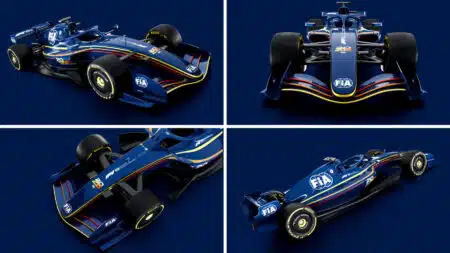
Drivers will use a steering wheel button to switch between modes, but activation will be restricted to designated zones for safety.
With the active aero system, both the front and rear wing elements move together to maintain aerodynamic balance. Adjusting only the rear wing (as with DRS) would create instability, so the front wing must also adapt to ensure predictable handling.
While DRS was primarily an overtaking aid, the new active aero system serves the purpose of managing energy consumption, as reducing drag on straights is essential for efficient energy use with power units that will rely much more on electrical energy.
Overtake mode
The freedom of use of the new system could mean that its effects on boosting overtakes are cancelled if the driver running in front decides to use the Straight mode at the same time as the driver behind.

DRS is no more, but rear wings can still be opened to cut drag
FIA
That’s why a new Overtake mode will be introduced as well next year.
When the driver behind is within one second of a car ahead, they will be able to deploy extra electrical energy (up to 0.5MJ, which is roughly equivalent to 67bhp) from the MGU-K with the manual override button. That will produce a DRS-like boost for a short period of time.
The leading car’s energy deployment will taper off after 180mph, while the car behind can use the extra power from Overtake mode up to 209mph.
The hope is the speed differential will mimic the effect of the DRS and allow overtaking.