


How fast is Formula 1's safety car? Mercedes-AMG GT Black Series specs
Formula 1 uses both Mercedes and Aston Martin safety cars. Here's why - and how they are different

The Mercedes safety car leads the field at Silverstone
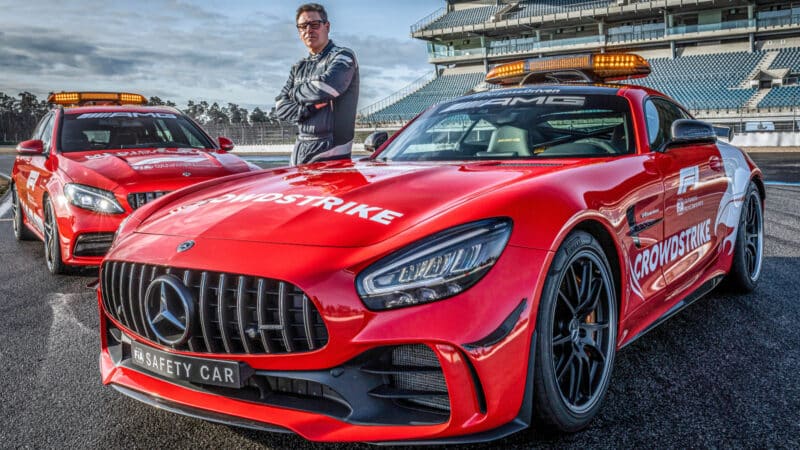
The Formula 1 safety car is capable of speeds that would place it firmly among the fastest road-derived cars in the world. That performance is not incidental. It is required to ensure that modern Formula 1 cars can continue operating within their optimal performance window during neutralised periods.
When the safety car is deployed, it must control the pace of the field without allowing tyre temperatures, brake energy or aerodynamic performance to fall away.
As cornering speeds and downforce levels have increased, so too has the minimum speed the safety car must maintain, particularly through medium, and high-speed corners.
The Mercedes-AMG GT Black Series meets those requirements by combining high straightline speed with unusually strong cornering performance for a road-based car.
Its acceleration allows it to pull the field away cleanly after a restart, while its braking capacity enables late, consistent deceleration without excessive heat build-up. More significantly, its aerodynamic package generates close to 250kg of downforce at racing speeds, allowing higher minimum corner speeds than previous generations of safety car.
This matters because modern Formula 1 cars are sensitive to airflow consistency. A safety car that is too slow through corners forces drivers to weave and brake aggressively to retain temperature, increasing the risk of mistakes and reducing the quality of the restart.
Mayländer drives the safety car
Mercedes
In operational terms, the safety car is driven close to its limits.
Bernd Mayländer routinely runs laptimes that would be unremarkable for a GT racing car but demanding for a road-derived platform carrying FIA lighting, communications and monitoring systems. The Black Series’ cooling capacity, braking hardware and tyre specification are all chosen to support that repeated high-load use.
From 2026 onwards, Mercedes will be Formula 1’s sole safety car supplier as Aston Martin, which previously shared safety and medical car duties, will no longer provide vehicles.
The safety car headline figures – 325km/h top speed and sub-3.5-second acceleration – are less about spectacle than necessity.
Formula 1’s safety car is fast because, in today’s championship, it has to be.
How different is the safety car from the road car – and why not use a GT racer?
Although it is based on a production model, the Formula 1 safety car does not run in standard showroom specification. The Mercedes-AMG GT Black Series used by the FIA receives a number of targeted modifications to support sustained circuit use and operational requirements.
These include upgraded cooling systems, reinforced braking components, revised suspension calibration and a dedicated tyre specification capable of repeated high-load running. FIA-mandated lighting, communications, data and control systems are also integrated, along with additional electrical capacity and safety equipment.
Despite these changes, the car remains mechanically close to its road-going base. That is a deliberate choice, and it explains why Formula 1 does not simply use a GT3 or GT4 racing car in the safety car role.
A GT racing car may be faster in some conditions, but it is optimised for competition rather than control. Such cars typically operate within a narrow performance window, require specialist set-up changes and aggressive tyre warm-up, and are not designed to deliver consistent behaviour across every circuit, weather condition and race scenario.
The safety car, by contrast, must be predictable, repeatable and universally deployable. It needs to be fast enough to maintain tyre and brake temperatures for the field, but not so fast or sensitive that it introduces variability of its own. A production-based platform provides the FIA with a stable and reliable reference that a pure racing car cannot.
Mercedes F1 safety car – technical overview
| Specification | Mercedes-AMG GT Black Series |
|---|---|
| Engine | 4.0-litre V8 twin-turbo |
| Power | ~720hp |
| Torque | ~800Nm |
| Transmission | AMG dual-clutch |
| 0–100km/h | ~3.2s |
| Top speed | ~325km/h |
| Weight | ~1,520kg |
| Downforce @ ~200km/h | ~249kg |
| Aero package | Large rear wing, front splitter, track-focused bodywork |
| Driver | Bernd Mayländer |