


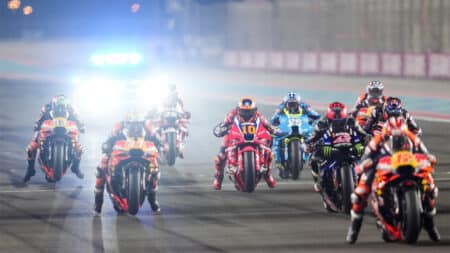
In the case of MotoGP, the Liberty-owned commercial-rights holder MotoGP SEG (formerly Dorna) brings a lot of firepower with its ‘product’, the high-level set-up and broadcast deals when a grand prix comes to town. But its engagement at national level is separate area and one where both parties often end-up pointing at each other: grand prix organisers might want more flexibility and proactivity from MotoGP, while MotoGP SEG asks the locals for strong campaigns in their market to drive interest and fans to the grand prix.
“I think there are great stories about the riders that are not being told, and that is potential to unlock,” Epstein offered when asked what he feels MotoGP could be doing better. “We need to help them [American fans] find a way to connect because there are some great personalities, and that is what Drive to Survive and F1 figured out. There is a person under that helmet and once people discover that then they can become more invested in it and will help the sport grow.”
“MotoGP is a super-exciting sport and we need to get more people to see it,” he shrugged.

Exciting racing isn’t MotoGP’s problem. Getting people to see it is
Red Bull
For its part, MotoGP SEG is not twiddling its thumbs. In the second half of 2025 it established a new internal team to work with promoters, and its marketing has progressed massively in terms of data collection and campaign creation. Five years ago, the company barely had a marketing department. American former CCO Dan Rossomondo helped to build this component with a fierce period of recruitment. The department is now led by tireless ex-Red Bull Racing Marketing boss Kelly Britain. There is a company-wide remit to push MotoGP to as many new eyeballs as possible and the American market is a hefty target away from the core fandom in Asia, southern Europe and South America.
“This is one of the biggest events on the F1 calendar and has been for a few years. Of course, we are on a different point in our journey…but it does showcase what the possibilities are and what the potential is,” Carlos told us in his temporary office space in COTA when we asked for some reflection in the wake of the Epstein chat. “I think we need to do our thing, authentic to MotoGP, but we are coming up with ideas. There are two parts: how to get the people here to have a better time and improve their experience and then also getting more of them! It’s a chicken and egg thing…but we want to do more with this event.”
Crucially COTA is one of the very few motor sport sites in the US that can accommodate MotoGP’s priorities for rider safety and the needs of the series, as well as having the infrastructure for growth, like its 15-mile proximity to Austin and the international airport. “It’s an incredible facility and not only one of the best in the world but one of the only ones for MotoGP on this continent,” Ezpeleta said, diplomatically but also earnestly. “All of us want to see ‘more’, and it takes time to see the impact of what we are doing but we have a lot [coming] for next year. The relationship with Bobby and the circuit is really good and they have made a lot of investment in the track to get rid of the bumps, more for MotoGP than anything else.”
If COTA thinks that MotoGP’s soul can be better exploited to an American audience, then MotoGP SEG also believes that the circuit could engage further the 1 million+ population of Austin (and more than 31 million in Texas); a city renowned for cultural events. “I think everyone that comes to COTA each year and experiences MotoGP up close; they love it. We just need to get more of them through the door. For us, it is also a case of captivating Austin and letting people know there is a big event going on at the circuit,” Carlos says carefully. “I think we are in the right direction and it’s just a matter of making another step.”
