
“Later we moved to non-distorting gas-flux brazing, and there was less difference between customer and team cars. In 1959, the F1 team was in a corner of the Hollyfield Road shop, so the customers could walk around and see everything. Then John rented two lock-ups from the pub next door, reached by a bridge [others say a plank!] over the River Mole, and that was the F1 department for a while.
“There were about 14 people in production, and three or four in R&D, where I started before I specialised in chassis. I built the Indycar and two Tasmans as well as the F1 frames. I can still recognise my own chassis when I go to the Goodwood Revival.
‘Then there were the customer ‘kits’ — we’d supply all the tubes but no chassis plate, and they’d assemble it. No Purchase Tax, you see.
“I think one of the reasons Cooper was such a success was that everyone enjoyed themselves. There was a very dose nucleus of us for many years. John claimed afterwards that he knew what went on, but he didn’t know the half of it. Even Jack Brabham — I remember him filling a cardboard box with acetylene gas and blowing it up in the pits.”

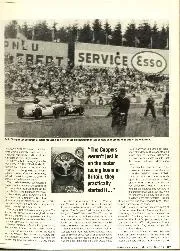
Masten Gregory manhandles the T51 round AVUS
Grand Prix Photo
Eddie Stait: “I was Owen’s right-hand man in the design office at this time. He was more of an artist than a scientist; he got the proportions about right by eye. There’s a lot of fuss talked about the curved tubes — they aren’t that bad. If you stick to straight tubes, it’s harder to turn corners, so you need more of them. The main tubes were sent away to be bent: they were filled with sand, then bent around quite a crude pattern. The curves were never quite where you expected, so we had to send a 25ft tube and then trim off.
“Owen would detail the whole chassis, but some things like damper positioning were exploratory. We would lay them down, mark them up, then weld the mounts. There were only a few adjustment choices — different wishbone pivot points or adding a bit of rubber on the damper to add a bit of rising rate.
“What I remember most about the Cooper days is the fun we had.”
‘Ginger’ Devlin: “During the championship years I was the third race mechanic, alongside ‘Noddy’ Grohmann (Jack Brabham’s) and Mike Barney (Bruce McLaren‘s). Jack himself was a very capable engineer and a bit of a thinker. The difference between him and Bruce was that if Jack asked for a change, you knew he’d really thought it through; if Bruce asked for a change, often as not he just wanted to suck it and see. Of course, there was always Ron Tauranac in the background behind Jack. Ron was not popular at Cooper’s, but I’m sure that some of his ideas would feed through Jack.
“Every Cooper wheel was turned by an old bloke called Len – he was a wizard”
“The supply situation was never easy — we were always waiting for something. For instance, every Cooper wheel was turned by an old bloke called Len, who was the foreman at a machine shop in Kingston, and who came in on evenings and at weekends. He was a wizard — did it all with a 6in rule on a big old lathe in the corner.
“Driveshafts were roughed out at Hollyfield Road, then sent away for finishing. They were machined from a huge pile of Dennis lorry shafts Charlie had bought — very strong. The supply lasted for years. And we made our own steering wheels: we had the flats stamped out locally, then a bloke called Fred put an alloy half-round bead on the front and a rubber one on the back. Then they were wrapped in leather by the people who upholstered the seats for us, and we engine-turned them using a drill, a bottle cork and some valve-grinding paste.