


Archive
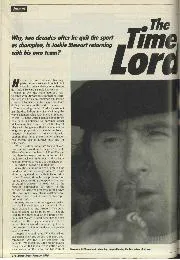
The Time Lord
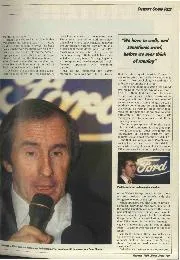
Why, two decades after he quit the sport as champion, is Jackie Stewart returning with his own team? He may, as one Ford executive suggests, be the customer from hell,…


Stewart celebrates his victory in the 1968 US GP
When Lewis Hamilton, George Russell and Lando Norris climbed onto the Barcelona podium together, the statistic attached to it reached back further than most people watching had any reason to expect, considering the huge success of British drivers in a 58-year span.
Not since Watkins Glen, 1968, had three British drivers swept a Formula 1 podium.
Fifty-eight years is a long wait for a coincidence of nationality to repeat itself, and the gap is explained partly by chance and partly by the fact that grids stopped being so thoroughly British long before they became so thoroughly multinational.
But the 1968 United States Grand Prix was not really a coincidence either.
It was the convergence of three careers moving in three different directions; at one moment, they all happened to be capable of occupying the same piece of track at the same time.
Jackie Stewart, Graham Hill and John Surtees arrived at Watkins Glen at very different points in their careers.
One was about to become the sport’s biggest star. One was at his peak, soon to have two titles to his name. And one was nearing the end of a career that had reached its crowning glory four years earlier.

Stewart was a year away from his first title
Grand Prix Photo
It’s worth remembering that in 1968, F1 used the classic two-session qualifying format that was standard from the championship’s inception in 1950 all the way through to 1995, running on Friday and Saturday.
Stewart had been the fastest driver at the Glen all weekend.
His Matra-Cosworth set the first day’s fastest time of 1min 4.27sec in a needle match with Chris Amon‘s Ferrari that pushed both men under the 1min 05sec barrier for the first time that weekend.
Then Stewart broke a stub axle in Saturday’s final hour and coasted to a stop, the wheel held on by nothing but the disc calipers, unable to defend the time.
Pole went instead to Mario Andretti, on his Formula 1 debut, who shaved a further 0.17sec off the fastest lap time in a Lotus he had barely learned to drive on a circuit he had never raced.
Stewart didn’t need pole, however. He just needed the first corner, and he took it under braking, diving inside Andretti at the loop before the first lap was even finished.
From there, the race became less of a contest and more of a demonstration, particularly after Andretti retired on lap 32 with a clutch issue.
Stewart led from lap 2, set the fastest lap of the afternoon at 1min 05.22sec on his way to a new track record, and crossed the line 24 seconds clear of his closest rival.

Stewart started second, but was quick to take the lead
Grand Prix Photo
There was a moment, late on, when his own pit crew hung out a sign reading ‘OIL PRES’, but there was nothing to it: the V8 was running perfectly, the gauge steady throughout. It was the closest the afternoon came to drama in his car.
It was his third win of a season in which he had spent long stretches driving with a broken wrist, and his third of the year for the Tyrrell-run Matra squad he had followed his old Formula 3 boss Ken Tyrrell into.
The result moved him to within three points of Hill at the top of the championship with one round left, a gap that would come down to six points separating three men, Hill, Stewart and Denny Hulme, heading into the Mexican GP finale.
Stewart would not win the title in 1968.
He would win it the year after next, and then twice more, but the manner of this performance, imperious from a man not yet a world champion, sitting comfortably ahead of two men who already were, told its own story about which way the decade’s balance of power was shifting.

Hill would go on to take the title, his second
Grand Prix Photo
Hill’s afternoon began going wrong before the first corner was even behind him. As Stewart dived past Andretti at the loop, Hill braked hard, and the steering column shot forward, pinning his fingers against the dashboard.
Freeing them knocked the dashboard switches out of position, and by the time he had sorted himself out, Amon’s Ferrari had gone by.
The column never fully settled for the rest of the afternoon; it kept working loose in its slightly oversized collar, a low-grade mechanical irritation Hill simply had to drive around for two hours, in a year when Lotus had already lost Jim Clark and was leaning on Hill, its talisman, to hold the team together.
He held the team together by finishing second, 24 seconds behind a driver — Stewart — he had no answer to, his Cosworth V8 running so close to empty by the finish that a check after the cool-down lap found barely a pint of fuel left in the tank.
While it wasn’t a winning drive, it was a championship leader’s performance: limit the damage and bank the points, maximising everything to achieve the best possible result.
Second place at Watkins Glen kept Hill exactly where he had been all weekend: at the top of the standings, with Mexico three weeks away and the title his to lose rather than win.
As it turned out, he wouldn’t lose it.
Hill’s second championship, six years after his first with BRM in 1962, would be confirmed in Mexico by a margin of eight points over Stewart, with Hulme third.
It was the form of a driver at the peak of his powers and his authority within the sport, a status the steering column at Watkins Glen did nothing to dent, because the closing laps never put him under serious threat from anyone behind.
The afternoon required Hill to be solid rather than spectacular, and being solid was, by 1968, something close to his trademark.

Surtees’s Honda wasn’t competitive enough in 1968
Grand Prix Photo
Surtees inherited his podium place rather than earned it on outright pace.
For most of the race, he ran fourth or fifth, 10 seconds adrift of Dan Gurney in the battle for what both men knew was realistically third, behind the unreachable Matra and Lotus ahead.
The Honda cars were not fast cars by the standards of 1968: one had spent practice waiting for an engine flown in from Tokyo to replace one that had failed at Monza, the other had punctured and then broken a crown wheel and pinion in the wet first session.
Surtees had built his reputation and his 1964 world championship with Ferrari, on machinery that could win outright. The Honda couldn’t, and had not been able to for some time.
What changed his afternoon was Gurney’s tyre, slowly deflating through the final laps without the American immediately realising why he was losing pace.
A patient Surtees closed the gap lap by lap and went past on the penultimate lap of the race to take third, the place he would hold to the flag. It was not a drive that announced itself the way Stewart’s did, or that demanded respect the way Hill’s controlled damage-limitation did.
Instead, it was a result built from outlasting a rival with worse mechanical luck rather than beating his pace, in a season that had given Surtees little else to work with.
By 1968, Surtees remained the only man in the sport’s history to have won world championships on both two wheels and four, a distinction nobody else has matched even now.
But Watkins Glen sat four years on from his title year, in a team no longer capable of giving him a car to match the talent, and a third place arriving via someone else’s puncture was an honest summary of where his career stood.
He wasn’t finished, but his career wasn’t what it had been, either.

The 2026 Barcelona-Catalunya podium
Grand Prix Photo
What the result amounted to, away from any podium ceremony, was three different competitive situations showcasing themselves on the same Sunday afternoon at the same circuit.
It would be 58 years before a similar scenario repeated itself, even though the drivers’ situation is not exactly the same as it was back then and the grid is worlds apart now.
F1 fields in 1968 included far more British names to begin with, simply by the numerical weight of where Formula 1’s constructors and most of its drivers happened to come from.
Barcelona’s repeat of the trick in 2026 came from a different mathematics altogether, three of the grid’s best contemporary drivers happening to share a nationality rather than a nationality happening to dominate the grid the way it did in 1968.
And yet some similarities are easy to see.
Norris arrived in Barcelona as a world champion, his title won the previous season, carrying a similar status to the one Hill carried into Watkins Glen but not, this time, the same command of it.
Norris in 2026 has the title without, at least for now, the form to defend it with authority.
Russell, still without a championship of his own, fills the role Stewart filled in 1968, the driver whose moment has not yet arrived but whose pace increasingly suggests it will.
Hamilton is the harder comparison to make cleanly, because his is not quite Surtees’s story. Surtees was fading in 1968 because the machinery beneath him no longer matched his talent.
Hamilton, having refound his form and with a competitive Ferrari, is still chasing an eighth title that would extend rather than complete his record, so he occupies a stranger kind of late-career territory than Surtees did, more unresolved than simply declining.
The comparison holds at its edges and breaks down a little in the middle, which is probably the right balance for a parallel separated by 58 years.
If you look closely, though, neither podium was really a story about nationality, but about three different points in three different careers, sharing the same piece of track on the same afternoon.
