Italy has waited 73 years for this. When Kimi Antonelli crossed the finish line at the Mexico City Grand Prix, he ended the longest gap between Italian world champions in Formula 1 history and became the third man from his country to win the title.
The first two are Giuseppe Farina and Alberto Ascari. Farina took the inaugural championship in 1950, at 43, in an Alfa Romeo. Ascari followed with back-to-back titles for Ferrari in 1952 and 1953, at 34 and 35, and he remains the only Italian to win the championship in a Ferrari.
Then came nothing. Italian drivers won races, led championships and finished runners-up, but the crown kept going elsewhere.
Antonelli has now ended that run at just 20 years old, less than half the age Farina was when he won. He did it in a Mercedes rather than a Ferrari, so the Italian dream of a champion in red is still waiting. But the wait for an Italian champion is over.
Here are the Italians who got there first, and one more who has a claim to an Italian story.
Giuseppe Farina, 1950: the first champion
Farina was the first Italian, and also F1’s, world champion
Grand Prix Photo
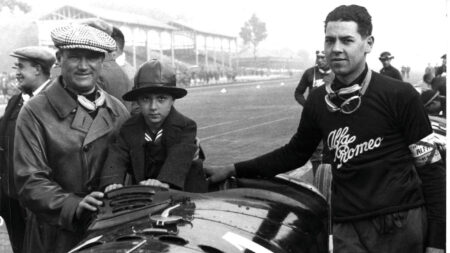
On 13 May 1950, Silverstone hosted the first round of the first Formula 1 world championship, and Giuseppe “Nino” Farina won it. He led an Alfa Romeo 1-2-3, becoming one of only three drivers to win on his world championship debut (alongside Johnnie Parsons and Giancarlo Baghetti), although the feat is not that significant considering it was also F1’s first ever race.
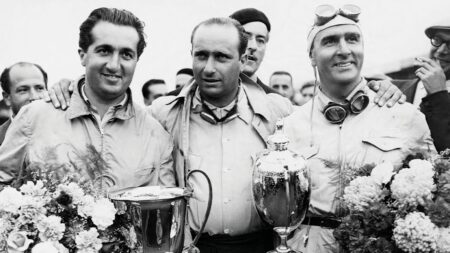
Alfa’s 158 “Alfetta” was a pre-war design dating to 1938, yet it was still far ahead of everyone else and won all six rounds it contested. That left the title to its three drivers: Farina, Juan Manuel Fangio and Luigi Fagioli, nicknamed the three “F”s.
Farina, a Turin-born doctor of political science, won in Britain, Switzerland and Italy, and Fangio took the other three.
Only a driver’s best four results counted, so it all came down to Monza on 3 September.
Fangio led on 26 points to Farina’s 22, and Farina needed to win and take the fastest-lap point; any Fangio score would have been enough to deny him.
Fangio started from pole, but his own Alfa retired with a gearbox problem before he took over team-mate Piero Taruffi’s car. That car too suffered engine failure, and Fangio was out on lap 34.
Farina won and finished the season on 30 points to Fangio’s 27.
Alberto Ascari, 1952: the perfect season
Ascari en route to victory at the Nürburgring in 1952
Grand Prix Photo
When Alfa Romeo withdrew after 1951, the championship ran for 1952 and 1953 to Formula 2 regulations, and Ferrari’s 2.0-litre 500 was the car to have. Alberto Ascari, born in Milan, was the man to drive it.
He was Ferrari’s lead driver and the son of Antonio Ascari, the Alfa Romeo star killed at Montlhery in 1925 when Alberto was seven. He had finished second to Fangio in 1951, and in 1952 he made no mistakes.
He skipped the Swiss Grand Prix to qualify for the Indianapolis 500, then won every race he started in Europe: Belgium, France, Britain, Germany, the Netherlands and Italy.
Between the Belgian and Dutch rounds he led 304 consecutive laps, a record that still stands. He clinched the title at Monza on 7 September with his sixth straight win, giving Ferrari its first drivers’ championship.
He finished on 36 points (53½ before drop scores), and it was the first of the two-title run that made him the first double world champion.
It was a rare example of total dominance in the sport’s early years: a driver winning every championship grand prix he started, in the best car, at the peak of his powers.
Alberto Ascari, 1953: the streak
Ascari scored his final F1 win in Switzerl
Getty Images
Ascari began 1953 by winning the first three races, in Argentina, the Netherlands and Belgium.
With his last six wins of 1952, that made nine consecutive victories, a record that stood until Sebastian Vettel matched it in 2013.
The run ended in France, where he finished fourth, and he added wins in Britain and Switzerland to take five in total. It wasn’t a perfect season: he finished eighth in Germany and retired at Monza, where he was denied a home victory. But the title was never in doubt, and he finished on 34½ points (46½ before drop scores).
The Swiss Grand Prix was his last win. He left Ferrari for Lancia in 1954, and the car that was to carry him back to the top was not ready until the end of the year.
In May 1955 he crashed his Lancia into the harbour at Monaco and escaped with a cut nose, swimming to safety. Four days later, testing a Ferrari sports car at Monza, he crashed at the corner that now bears his name and was killed. He was 36.
His 1953 title was Italy’s last for 73 years, until Antonelli came along.
Bonus entry: Mario Andretti, 1978 – the Italian who won as an American
Andretti took his title under American citizenship
Grand Prix Photo
Technically not an Italian when he took his F1 title, Mario Andretti was born on in Montona, Istria, then part of the Kingdom of Italy and now Motovun in Croatia.
His family left after the war and moved to the United States, and by the time he made his F1 debut at the United States Grand Prix at Watkins Glen in 1968 he was an American citizen.
He raced under the American flag, and when he won the world championship in 1978 he did it as one.
He did it in the ground-effect Lotus 79, which made its debut at Zolder and won first time out. Andretti won six races and took nine poles, and his main rival was team-mate Ronnie Peterson.
He arrived at Monza leading Peterson by 12 points, and the title was decided there. Peterson was injured in a first-lap crash and died the next day, and Andretti had won the championship.
It was a bleak echo of 1961, when Phil Hill, the only previous American champion, took the title at Monza on the day Wolfgang von Trips was killed. Andretti remains the last American to win it.
He was an Italian by birth and an American by choice, and the Italian fans treated him as one of their own.
Pablo has been covering motorsport (mainly F1 and MotoGP) as an editor and writer for over 20 years, having worked for Autosport and Motorsport.com before joining Motor Sport Magazine.