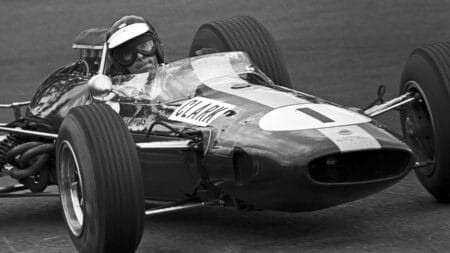
Time certainly hurtles on. For any of us around and interested back in 1966, a sea-change to Formula 1 took place which was at least as far-reaching as anything we are experiencing now with the new 2026 regulations looming. The big promotional F1 slogan was then ‘The Return of Power’, with the old 1½-litre Formula of 1961-65 being replaced by a full 3-litre category.
How long ago? Sixty years, with the 3-litre Ferrari V12 312s about to emerge, alongside the Cooper–Maserati V12s, the outsider Repco Brabham V8, and what promised to be the best and most complex of them all – the BRM H16. How were things then in the motor racing world? Most constructors remained reliant upon interested fuel and oil company patronage to keep them afloat. In the wider motor sporting world the weekly Autosport began the year with ten to a dozen back pages of classified ads, Jack Brabham Motors offering a 7000-mile Triumph Spitfire for an expensive £595, an 1100cc Cosworth ex-Formula Junior engine complete with Weber twin-choke carburettors priced at £200 (or £120 “engine only”), while the historic first prototype Aston Martin DB3S (chassis DB3S-1) ex-Reg Parnell, Peter Collins and Roy Salvadori could be yours for £1250. We knew it all made sense… each remained way beyond most available means.
But January 1966 issues of the weekly magazine also carried the first description of the latest 3-litre Cooper–Maserati, with reports from the London Racing Car Show featuring the Porsche Carrera 6, the second-series American V8-engined Lola-Chevrolet T70 and the startlingly lightweight plywood monocoque Costin-Nathan sports car too. The Cooper-Maserati was greeted there as looking “…the very essence of speed” while John Bolster noted “…it is splendid that it has been completed well before the season starts”.
From Italy came news of the first 4-litre 330 P3 Ferrari sports-prototype prior to its racing debut in the Sebring 12 Hours, while the rear end of the latest Ferrari 250 LM had been modified with an appallingly ugly rectangular box grafted on as “necessary for the 1966 regs”. Not only F1 was changing – the FIA rule makers’ fingers interfered everywhere.
Into February, we saw the Ford GT Mk IIs finish 1-2-3 in the Daytona 24 Hours, humbling Ferrari. Simultaneously news was released from the Goodwood Road Racing Company that “after due consideration” they had “decided that the potential speed of the new generation of the unlimited capacity sports and GT cars poses a serious problem if they are to ensure adequate protection for spectators. It has therefore been decided to impose a 3-litre limit on these types of machines. This decision will also affect the current ’66 F1 racing cars which are regarded in the same light. For this reason the organizers have decided not to promote races for such cars at the West Sussex circuit…”.
In contrast, the coming thing was kart racing, with more than 600 relevant licences having been issued through 1965 and 200 entries at a Brands Hatch meeting providing some extremely close and exciting racing.
Into March the year’s first Goodwood Members’ Meeting was run while the BARC announced that for 1967 its annual springtime International meeting would be moved from the Sussex circuit to Silverstone “…because of the decision at Goodwood not to allow 3-litre F1 cars to compete there.” Still the club planned “…to continue with a full programme at Goodwood covering club and national events, and it also intended to run the 1967 Easter Monday event at Goodwood under a national permit”. It never happened – indeed the final BARC Members’ Meeting until the 1998 Historic Revival would be run that summer.
“The first prototype Aston Martin DB3S could be yours for £1250”
While Goodwood bit the dust as a racing venue, it remained a primary testing site. It was there that the new breed of 3-litre Formula 1 cars were often to be seen, and heard, lapping at unprecedented speeds in the absence of spectators. It was here that the Cooper–Maserati V12s completed much of their early running, together with the Repco Brabham V8s and the BRMs.