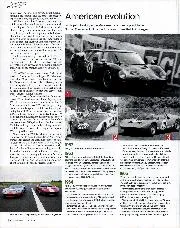
Ford’s assault on the Le Mans 24 Hours in the 1960s produced one of the most famous rivalries in motor sport history.
Determined to beat Ferrari at its own game, the American manufacturer poured huge resources into endurance racing and, after two years of frustration, its GT40 finally delivered the breakthrough in 1966.
That victory was the first of four in succession.
Across the next three years, Ford’s cars won at Le Mans in very different circumstances: with an all-American driver pairing, through the efforts of a privateer team, and in a last-lap thriller that brought the GT40’s remarkable run to a close.
As Ford prepares to return to the top class at Le Mans in 2027 with its new GT41 Hypercar, we revisit the four victories that established the GT40 as an endurance racing icon.
1966: Ford finally beats Ferrari
Ford finally conquered Le Mans in 1966, with Bruce McLaren and Chris Amon taking the first of four consecutive victories for the GT40
Ford
Ford’s first Le Mans victory was the culmination of a campaign that had begun with a very public ambition: to defeat Ferrari at the world’s greatest endurance race.
The GT40 had shown speed in its first two attempts, but it had failed to reach the finish in either 1964 or 1965. For 1966, Ford went back to the drawing board, reorganised its racing operation and produced the GT40 Mk II, powered by a 7-litre V8.
The scale of the effort was striking. Ford had Shelby American and Holman & Moody running its cars, with additional entries from Alan Mann Racing.
Ferrari also arrived with a strong line-up of its own, but as the race progressed, the American cars began to take control. Ferrari’s challenge gradually unravelled through mechanical problems, while Ford’s surviving entries moved towards an unprecedented result.
By Sunday morning, Ford held the first three positions. The question was no longer whether it would win, but which of its drivers would take the victory.
Ford management decided to stage a formation finish, bringing the leading cars across the line together for a photograph that would underline the scale of its achievement.
The No2 Ford GT40 Mk II of Bruce McLaren and Chris Amon leads Ford to its first overall victory at Le Mans
Ford
However, officials ruled that a dead heat wasn’t possible: because McLaren and Amon had started further back on the grid, their car had covered a greater distance. They were therefore declared the winners, with Miles and Hulme classified second and Ronnie Bucknum and Dick Hutcherson completing the podium.
It was a bitter outcome for Miles, who had played a major role in developing the car and had been in contention for an extraordinary endurance racing triple after winning at Daytona and Sebring earlier that year.
Ford had achieved its goal, but the manner of the finish left a lasting sting. The manufacturer had beaten Ferrari – and done so with a 1-2-3 – but its first Le Mans victory was remembered as much for the controversy as the result.
1967: An all-American victory
Ford returned to Le Mans in 1967 to defend its crown with a new weapon. The GT40 Mk IV was a more extensively developed car, with a distinctive body designed around improved aerodynamics.
Unlike the Mk II, it was built in the United States, and Ford was determined to show that its success the previous year had not been a one-off.
The entire car weighed 2660lb, 300lb less than the Mk II, such was the redesign of the chassis.
The winning combination this time was Dan Gurney and AJ Foyt, two of America’s biggest racing names.
Gurney was an established international star, while Foyt had made his reputation in American oval racing. Together they formed an entirely American pairing in an American-built car, entered by Shelby American – an expression of Ford’s ambition to take on Europe’s best on its own ground.
Dan Gurney and AJ Foyt took Ford’s second consecutive Le Mans victory in 1967
Ford
The pair led for all but the opening 90 minutes, keeping the Mk IV ahead of the opposition as the hours ticked by.
There were dramatic moments elsewhere in the Ford camp: a major accident involving Mario Andretti’s car during the night eliminated several entries, leaving the American driver with three broken ribs after one of the car’s brake pads was installed backwards by a mechanic.
Gurney and Foyt stayed out of trouble. They completed 388 laps, covering 5232.9 kilometres – the first time a Le Mans winner had exceeded 5000km. It was a record-breaking performance and Ford’s second consecutive victory.
The celebrations were memorable, too.
On the podium, Gurney shook a bottle of champagne and sprayed it over the people around him, something that hadn’t been done before. The gesture became a tradition for race winners, giving Ford’s success a legacy beyond the result itself.
1968: The Gulf GT40 takes over
Ford’s third successive Le Mans victory came through John Wyer’s privately run Gulf team
Ford
Ford’s third consecutive Le Mans victory came in rather different circumstances. Having achieved its original ambition of beating Ferrari, Ford had ended its factory GT40 programme after the 1967 season.
Ferrari also stayed away from the 1968 race, withdrawing from sports car competition amid the fallout from the new regulations.
The responsibility for keeping the GT40 competitive therefore fell to John Wyer’s privately run, Gulf-backed team, JW Automotive.
The rule changes had played into Wyer’s hands. With prototypes restricted to three litres and production-based sports cars allowed up to five, the GT40 remained eligible while the more powerful Mk IV was ruled out.
Wyer’s team adapted the car for the new regulations, and Pedro Rodriguez and Lucien Bianchi duly delivered another victory.
The winning car overcome the challenge of Porsche’s new 908 prototype.
The GT40 was no longer the newest or most advanced machine in the field, but its speed and durability proved decisive over 24 hours.
The win was significant beyond the immediate result. It gave Ford a third consecutive Le Mans victory and secured the 1968 world championship for Makes, with the French classic serving as the season finale.
The Gulf colours that had arrived at the top step of the Le Mans podium would be there again the following year.
1969: A last-lap thriller
By 1969, the GT40 was an ageing design, and Porsche had become an increasingly tougher rival, bringing its new 917 to Le Mans while Ford’s programme was now concentrated around John Wyer’s team.
Jacky Ickx and Jackie Oliver brought Ford’s remarkable Le Mans run to a close in 1969
Ford
Few would have expected the old car to extend its winning run but, as it turned out, it had one more extraordinary result in it.
The race began with a now famous protest.
Traditionally, drivers had sprinted across the track to their cars at the start, jumped in and driven away. Jacky Ickx considered the procedure dangerous and refused to run. Instead, he walked deliberately to his GT40, strapped himself in and set off last.
The Belgian and team-mate Jackie Oliver had a long way to make up, but steadily worked their way through the field. Their progress was made more difficult by the conditions, including night-time fog and a slippery track.
The GT40 remains a Le Mans icon – dominating Le Mans from 1966-1969 – but its true origin story begins further back than Hollywood would lead you to believe
By
Andrew Frankel
But the pair stayed in contention as the race developed into a battle with Porsche.
The finish was incredibly close. Over the final laps, Ickx found himself chasing Hans Herrmann’s Porsche 908. The two cars traded the lead, with Herrmann appearing to have the advantage as the final lap approached.
On the final lap, Ickx deliberately let Herrmann through early on the Mulsanne Straight, pretending his car was running out of fuel. He tucked into Herrmann’s slipstream to save fuel. Then he used the 908’s fading brakes to his advantage and overtook under braking at the end of the straight.
Thanks to his bigger Ford engine and fully working brakes, Ickx held the lead and won by a few seconds.
It was a remarkable result for a car that had first appeared at Le Mans five years earlier. The winning chassis was the same one that had taken victory in 1968 with Rodriguez and Bianchi, making its back-to-back success all the more striking.
Ford’s fourth consecutive victory was its last in the 1960s, and the final overall Le Mans win for the GT40.
Pablo has been covering motorsport (mainly F1 and MotoGP) as an editor and writer for over 20 years, having worked for Autosport and Motorsport.com before joining Motor Sport Magazine.