 Great Read
Archive
Phil Hill: the sad F1 hero
It was, as Charles Dickens once wrote, the best of times and the worst of times. As Phil Hill completed the final laps of the 1961 Italian Grand Prix he…


Lewis Hamilton won in Bahrain, beating Nico Rosberg for the fourth race in a row. The roles were reversed in 2016
Grand Prix Photo
Formula 1 has a big contradiction at its heart: it’s a team sport, but it’s all about the individual drivers’ championship – that’s the title most fans care about, and the only one everyone remembers.
A decade ago, Lewis Hamilton and Nico Rosberg showed why, after setting up a season finale that would see both Mercedes team-mates headed to the Abu Dhabi season finale with a shot of becoming world champion.
Rosberg retired within days of winning that battle and clinching the title, a sign of how intense that battle had become: when drivers in the same car start fighting for the world championship, the garage can get split down the middle, engineers get cagey about sharing data, and the team principal suddenly has to make calls that’ll be picked apart for years to come.
Some of the best title fights have happened between team-mates. The pressure has produced everything from botched pitstops to double retirements. The rivalries have defined careers, ended friendships and sometimes they have resulted in the crown going to someone else entirely.
Below, you’ll find the most significant title fights between team-mates in F1 history, from Alfa Romeo’s three-way scrap in the very first world championship to that Hamilton and Rosberg battle that brought fireworks to the 2016 season.

Alfa Romeo’s “Three Fs” fought among themselves for the first F1 title, with Giuseppe Farina (pictured, in front) winning the three-way battle
Getty Images
The first-ever official Formula 1 World Championship was a season of domination.
Back then, Alfa Romeo’s 158 was arguably the class of the field, and its drivers, known as the ‘Three Fs’ – Giuseppe Farina, Juan Manuel Fangio and Luigi Fagioli – spent the season taking points off each other while everyone else watched a decent distance back.
There were three people in this particular intra-team fight, and it went to the last round at Monza, with Fangio leading the three.
His gearbox failed, so he took over Piero Taruffi‘s car (which was normal under the rules of the day) and that one let him down too.
Farina won the race and the title by three points, with Fangio second and Fagioli third. Alfa had the championship sewn up races before the end, but it took the whole season to work out what order its drivers would finish in.

Collins had a chance to win the 1956 title, but voluntarily handed his Ferrari to Fangio at Monza
Grand Prix Photo
Fangio moved to Ferrari after Mercedes pulled out of racing. There, he found himself driving the Lancia-derived Ferrari D50, and although it was quick, it was far from the most reliable machine on the grid.
On the other side of the garage, Peter Collins was in his first season at Maranello, and won in Belgium and France. Those wins meant that, at the end of the year, Collins arrived at the Monza finale with a mathematical chance of the title.
Then Fangio’s steering arm broke. Luigi Musso was asked to hand his car over and declined because it was his home race, and that meant Collins was in a position to win the title himself.
However, there was a twist: when Collins came in for a tyre check with 15 laps to go, he handed his Ferrari to Fangio without being asked, so Fangio finished second, shared the points and took his fourth championship. Collins ended up finishing third in the standings.
When asked about it afterwards, he said he was young enough to have plenty of time to win a title of his own. Sadly, he was killed at the Nürburgring two years later, still without one.

Von Trips and Hill arrived at Monza separated by four points, but the title fight was decided by the former’s fatal crash
Grand Prix Photo
Every so often Ferrari delivers a masterpiece of a car, and the ‘sharknose’ 156 was one such example.
When it hit the track in 1961, it was clear to onlookers that the championship was always going to be an internal affair – and that’s exactly what happened.
Maranello’s drivers Phil Hill and Wolfgang von Trips traded wins and points through the summer, and therefore arrived at Monza separated by four points – with von Trips ahead and on pole.
However, it wasn’t long before the title was decided – and in horrific fashion.
On the second lap, von Trips touched Jim Clark‘s Lotus on the run to Parabolica, and his Ferrari was launched into the crowd.
Von Trips was killed, along with 15 spectators. Hill won the race – and with it the title, by a single point, without knowing how bad his team-mate’s accident was.
Ferrari didn’t take part in the final round at Watkins Glen, but Hill had already done enough to become the first American world champion.

Hulme beat team owner Brabham to the 1967 title through consistency
Grand Prix Photo
Jack Brabham won the 1966 title in his own car, with his own name on the nose – a feat only he has achieved to this day.
However, a year later he found himself in second, beaten by his team-mate, and technically one of his employees.
Denny Hulme wasn’t faster than his boss, but he was more consistent, and that proved to be crucial in the eventual tight fight.
Brabham didn’t even have the fastest car that year – that was Lotus’s new Cosworth-powered 49 – and like other Chapman creations it was fast but fragile. With that in mind, consistency counted for more than outright pace.
Hulme won in Monaco and Germany and finished on the podium eight times. Brabham went into the Mexico finale five points down and finished second to Hulme’s third, which wasn’t enough to close the gap.
Hulme the employee took the title by five points.

Peterson was often fast enough to challenge Andretti, but Lotus’ clear number-one agreement made 1978 less of a fight
Grand Prix Photo
Lotus was the first team to properly crack ground effect: it was working on it in the 78, but it was in the 79 that it really perfected the formula.
In a different league to everything on the grid, it made for a fight between Mario Andretti and Ronnie Peterson. Only it wasn’t a fight at all: Peterson had signed as the clear number two and he stuck to his contract.
The Swede was often the quicker of the pair and he won in South Africa and Austria when Andretti hit trouble.

Jeez, who’d be the other guy? Neither basking in reflected glory nor withering in the shade is a good look/outlook for an ambitious Formula 1 driver. Imagine spending another long,…
The rest of the time he sat a few car lengths behind his team-mate and followed him home, completing a string of Lotus one-twos through the summer.
The title was settled at Monza, where Peterson’s car was caught up in a multi-car accident at the start.
He died the following morning from complications after surgery on his leg injuries, and Andretti – who clinched the championship that day – was in no mood to celebrate.
Peterson was classified second, 13 points behind.

Villeneuve put Ferrari’s interests ahead of his own championship hopes in his fight with Scheckter
Grand Prix Photo
Gilles Villeneuve was the faster of Ferrari’s two drivers in 1979, and he won three grands prix that year to prove it.
Jody Scheckter, though, was more consistent, which mattered even more for a championship run: he finished races and picked up points when the 312T4 was having an off day.
The decisive moment came at Monza, where Scheckter led and Villeneuve sat in his wheel tracks for the whole race rather than having a go.
He’d agreed to play the team game and kept to his word – even though a win would have kept his title hopes alive.
Scheckter became champion by four points and Villeneuve’s trustworthiness was cemented – key in his fateful feud with Didier Pironi three years later.

Williams’ 1986 title fight ended when Mansell’s tyre exploded in Adelaide; a year later, Piquet outlasted his team-mate to claim the championship
Grand Prix Photo
Weirdly enough, the closest championship in F1 history was fought between two team-mates who actually got on.
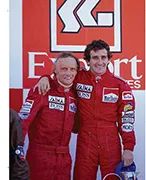
Alain Prost joined Niki Lauda at McLaren after missing out on the 1983 title with Renault – and jumped into the TAG-Porsche-powered MP4/2, which was comfortably the best car on the grid.
Prost was quicker over a lap and won seven races to Lauda’s five.
However, Lauda concentrated on race set-up, looked after the car and scored whenever Prost hit trouble.
After playing the long game throughout the year, Lauda took his third title by half a point – and Prost learned and developed a racing approach he’d use for the rest of his career.

Williams’ 1986 title fight ended when Mansell’s tyre exploded in Adelaide; a year later, Piquet outlasted his team-mate to claim the championship
Grand Prix Photo
Nelson Piquet arrived at Williams in 1986 as a two-time champion expecting to lead the team, but his team-mate Nigel Mansell thought differently.
Team boss Frank Williams spent the season recovering from the road accident that left him paralysed – and that meant there was nobody to lay down the law.
The result? A rapid Williams-Honda that won nine races in 1986 and somehow still lost the drivers’ title.
Mansell went to the Adelaide finale needing third, and come the race he was doing everything he needed to do – until his left-rear tyre exploded at around 180mph on the Brabham straight.
The team brought Piquet in for safety, and Prost won the race and the championship in a McLaren instead.
In 1987 there was no third party to spoil it. Mansell won six races to Piquet’s three, but the Brazilian was more consistent.
When Mansell crashed in practice at Suzuka and injured his back, the title went to Piquet with two races to go. He won it by 12 points, then promptly left for Lotus.

McLaren’s dominant partnership became one of F1’s defining rivalries, with Senna and Prost colliding at Suzuka in 1989 as their relationship finally broke down
Grand Prix Photo
The McLaren-Honda team won 15 of the 16 races in 1988 and produced one of the fiercest intra-team rivalries the sport has ever seen.
Ayrton Senna won eight to Prost’s seven, and although Prost actually scored more points overall, he lost to the dropped-scores rule – only a driver’s best 11 results counted.
Senna clinched the title at Suzuka after stalling on the grid and fighting back from 14th.
Things unravelled a year later: in 1989 the relationship fell apart after Senna broke a no-overtaking agreement at the first corner at Imola, and by the time they got back to Suzuka the two were barely speaking.
Senna needed to win to keep the title alive, but when he tried to overtake Prost on track, the team-mates crashed at low speed at the chicane.
Senna got going again via the escape road and won the race, but was then disqualified for cutting the chicane, handing Prost his third title.
Prost left for Ferrari, and the pair had a rematch at Suzuka a year later – this time at the first corner, when the two collided once again.

Hill defeated rookie team-mate Villeneuve to win the 1996 title, despite knowing that Williams had already decided not to retain him for the following season
Grand Prix Photo
Damon Hill spent 1996 winning races and leading the championship while knowing he’d not be retained the following season.
Frank Williams had already signed Heinz-Harald Frentzen for 1997, with the news coming out halfway through the season.
Hill was up against a rookie that year – Jacques Villeneuve – but one with serious pedigree. The Canadian arrived from IndyCar as reigning champion and Indy 500 winner, and proceeded to take pole on his debut in Melbourne. He followed it up with four wins, including Estoril, where he went round the outside of Michael Schumacher‘s Ferrari at the final corner.
That kept the title alive to Suzuka, where Villeneuve needed to win with Hill failing to score.
The rookie took pole but made a poor start, and later in the race a rear wheel came off his Williams.
Hill won the race and the title by 19 points, then went to Arrows, a team that had scored just a single point the year before.

Alonso arrived at McLaren as a double world champion, but rookie team-mate Hamilton immediately matched him
Grand Prix Photo
Fernando Alonso left Renault as double world champion and joined McLaren expecting to be its obvious number one.
Instead, his team-mate’s Lewis Hamilton‘s rookie season began with a bang: he was on the podium in each of his first nine races and won on his sixth attempt.
The drivers’ relationship came apart at the Hungaroring, where Alonso sat in his pit box during qualifying to stop Hamilton getting a final run – after the latter went back on an agreement on who would run first.
The Spaniard was given a five-place grid penalty, and the fallout fed into the ‘Spygate’ scandal that saw the Woking team excluded from the constructors’ championship and fined $100 million.
With two races to go, Hamilton led Alonso by 12 points and Kimi Räikkönen by 17. Then he beached his car in the gravel at the pit entry in China, and in Brazil a gearbox glitch dropped him down the order early on.
Räikkönen won both races and sidestepped the McLaren duel, winning the title by a single point, with Hamilton and Alonso tied on 109.
Alonso went back to Renault in 2008 after just one season at McLaren.

Red Bull’s 2010 title fight boiled over in Turkey and Britain before Vettel beat Webber and Alonso at the final round
Grand Prix Photo
Red Bull’s RB6 was clearly the fastest car of 2010, so it quickly became a fight between the team’s two drivers: Sebastian Vettel was the team’s protégé; Mark Webber was the veteran who felt as though he was not being prioritised.
In Turkey, Vettel tried to pass Webber but the two collided, throwing away a one-two.
At Silverstone things got worse: the team took a new front wing off Webber’s car, and gave it to Vettel after his own was damaged. Webber won anyway and told the team on the radio it was “not bad for a number two driver”.
The Australian led the championship until he crashed out in Korea, and then went to the Abu Dhabi finale second in the standings, eight points behind Fernando Alonso.
Vettel was third, 15 points behind the Ferrari driver – but he won the race while Alonso spent most of the evening stuck behind Vitaly Petrov’s Renault.
The result? He became champion without having led the standings once all season until the chequered flag.

Hamilton and Rosberg turned Mercedes’ dominance into a personal duel
Grand Prix Photo
The first three years of the V6 hybrid era handed Mercedes cars so far ahead that the title was always going to be decided between Lewis Hamilton and Nico Rosberg – two drivers who had been racing each other, and getting on, since they were teenagers in karting. That was about to change in a big way.
The situation unravelled in Monaco in 2014, when Rosberg went up the escape road at Mirabeau at the end of qualifying, bringing out yellow flags that spoiled Hamilton’s final lap and handed Rosberg pole.
The stewards cleared him, though Hamilton made it fairly clear he felt Rosberg’s mistake was intentional. Later that season at Spa, Rosberg clipped Hamilton’s rear tyre while trying to pass, forcing Hamilton to retire. This time, Brackley disciplined Rosberg internally.
Hamilton won 11 races to Rosberg’s five in 2014, but the title still went to Abu Dhabi because of the one-off double-points rule. Rosberg’s hybrid system failed during the race, and Hamilton won the championship by 67 points.
Hamilton took the title more comfortably in 2015, winning 10 races and wrapping it up with three rounds to spare. There was still tension, though: in Austin, Hamilton forced Rosberg wide at the first corner, while Rosberg later ran wide himself while leading, citing a gust of wind. Hamilton won the race and the championship. In the cool-down room, he tossed Rosberg the second-place cap, which Rosberg threw straight back.
A tense title-decider… no cap 😳🧢
The Mercedes duo of Lewis Hamilton and Nico Rosberg faced off in Austin 2015, with drama both on track and off it!
#F1 #USGP https://t.co/NINDRL1vkC
— Formula 1 (@F1) October 15, 2024
Rosberg won the first four races of 2016 – seven in a row if you include the end of 2015 – but Hamilton fought back. The two took each other out on the first lap in Barcelona and collided again on the final lap in Austria. Hamilton’s engine failure while leading in Malaysia proved decisive.
At the Abu Dhabi finale, Hamilton slowed the pace to bring Vettel and Max Verstappen into the fight, ignoring repeated instructions from the pitwall to speed up. Rosberg held on to second and took the title by five points. Less than a week later, he announced his retirement.