Hamilton vs Leclerc: Ferrari’s great gamble faces its 2026 reckoning
In Italy, Ferrari is a religion. Roberto Boccafogli reflects on Hamilton’s torrid first year in red and the path our veteran hero must take to finally win the hearts of the tifosi.
Italian journalist Roberto Boccafogli has been writing about motor racing since the 1980s and was Pirelli’s head of F1 communications from 2014-23
The most successful Formula 1 driver ever with the most successful F1 team ever: Lewis Hamilton and Ferrari…
How can we in Italy not sigh at the memory of the magic that accompanied Lewis’s first steps in red in January 2025? His arrival had been announced on February 1 of the previous year. From then on, in the media and in sports bars throughout Italy, came a flow of emotion and enthusiasm for the wonders that the partnership would undoubtedly provide from the following year onwards.
Ferrari was not struggling, after all. The previous year, Charles Leclerc and Carlos Sainz had brought home five victories (as many as the Prancing Horse had achieved in one season since 2018), and its challenge for the world constructors’ title – which Maranello has not won since 2008 – faded only at the last corner of the season, amid the misery of a final 14-point deficit to McLaren.
That 2024 world championship had featured clearly the best Ferrari in recent history, the most effective of the Frédéric Vasseur era. And while the SF-24 was asserting itself on the track, the team changed its appearance: away went technical director Enrico Cardile, who had migrated to Aston Martin. In his place arrived Loïc Serra from the orbit of Mercedes, where he had worked in great harmony with Hamilton. Ferrari was a team on an upward path. The stars seemed perfectly aligned and the following year, with the seven-time world champion at the wheel, surely even greater satisfaction would come. On paper at least, the partnership should have translated into at least a world title.
Lewis Hamilton’s sprint win in the 2025 Chinese GP seemed to signal the seven-time world champ’s arrival at the Scuderia
Ferrari
How bewildering now to think back to those days. And what melancholy for the fans, burned by the dream – and these are the burns that hurt the most. Hence the question: what remains today of all that passion? Especially in Italy, where almost all those who follow F1 are also fans of the red cars.
“The initial mass outpouring of enthusiasm for Lewis a year ago did not make Leclerc too happy”
One year ago, Hamilton posing in front of a Ferrari F40, inside the Fiorano circuit, looked like much more than just a photograph. He was almost an actor: long coat, hair braided, an enigmatic and knowing smile, as if he were whispering to fans: “Here I am! I’ve always been waiting for this moment. And you were waiting for it too.”
Lewis with a red F40; but his personal team wanted black
DPPI
Details of that day would be uncovered in the weeks to follow. Hamilton’s support team had wanted that F40 to be black. The choice of the photographer was not Ferrari’s, but instead reported to the communications team that the driver had brought to Maranello. Within Ferrari there was a half-insurrection. For such a shoot, the car could only be of one colour – red. And another fact that heightened the gossip – in all the official reportage of that day, there was no photo of Hamilton and Leclerc together, except for the classic mugshot in overalls and sponsors. This omission would also occupy the newspaper column inches in the days to come.
“In 2025, Hamilton was clearly beaten by his team-mate. That’s not a new trend for him”
And now we come to Leclerc. In 2019 he arrived in Maranello, where he was viewed as the pretender to the throne occupied by Sebastian Vettel. But from then on he absorbed every expectation and the very soul of the team, and won twice in his first season to become the favoured son. It is said that the initial mass outpouring of enthusiasm for Lewis a year ago, especially in official Ferrari communications, did not make Leclerc too happy.
But even if it were true that Leclerc felt overshadowed by his new team-mate, the performances on the track took care of balancing everything up. Even with a Ferrari that was much less competitive than anyone would have expected, Leclerc’s seventh season in red soon veered him towards internal supremacy. The numbers at the end of the championship say it all: he was the best Ferrari driver in qualifying 23 times (including sprints) against Hamilton’s seven; seven grand prix podiums against zero; 242 points to 156.
Within Italy, where Ferrari is part of life and culture, Leclerc has positioned himself even more firmly into a position he has now occupied for years: that of steering a ship which, since 2019, has too often been leaky. He has helped to steady the cause, often by draining into it all his reserves of immense natural speed. And then, it has to be said, there’s the state of crisis in which the Scuderia has been existing. Its SF-25 was never really up to competing regularly for victory, and that helped to disguise the internal situations of the team, including those between the drivers.
It is difficult to say whether Vasseur’s choices in communication were to deflect from Ferrari’s internal complexities, or to protect those around him. Many times it has been “we have not been able to express the potential”; “in qualifying we make too many mistakes, but in the race the pace is not bad” and so on, referring to gaps to McLaren, like a mantra. And then the attention is always diverted to the future, from possible changes in the technical pecking order due to the clampdown on flexible wings imposed in June, to the arrival of a new rear suspension, to a new floor… All this with a vague taste of promise, yet never backed up by the lap times.
Amid this growing depression, unimaginable only a few months earlier, the tifosi have gradually lost the strength and therefore the interest to focus on other aspects of the team. The McLarens dominating and uncatchable; Mercedes and Red Bull alternating behind them until they both finished ahead of the red cars in the standings… The topic of drivers has been almost forgotten.
However, one certainty remains. In 2025, Hamilton was clearly outclassed by his team-mate. That’s not a new trend for Lewis. George Russell had beaten him in two of their three years alongside each other at Mercedes. At the time, the blame was placed on the most recent change in the technical regulations, with cars featuring ground effect, which Hamilton had never found palatable. But Lewis’s year in red was disappointing in other respects too. If we remember the expectations on the eve of the season, we anticipated Leclerc probably being stronger in qualifying (he is phenomenal here) and Hamilton perhaps being stronger in the races. But instead the opposite happened. Initially outshone mercilessly by his team-mate in qualifying, Hamilton did manage to get close to him on Saturdays, and it was the races that produced little or nothing of Hamilton’s usual level.
And this ended up directing the fans’ last crumbs of hope in the direction of his team-mate, who was capable of at least scoring a few podiums – when they were not taken away by external factors. Not to mention Hungary where, after starting from pole, Leclerc dominated for two thirds of the race, only to find himself swamped after the second pitstop with an SF-25 that was suddenly slow and undriveable. Almost certainly (Ferrari has never officially admitted it) that was due to changes made to curb a wearing of the floor that was becoming critical – as had already happened in Spain.
At the start of 2026 there is no doubt that Sir Lewis must climb an Everest this year that also includes getting the better of his team-mate Leclerc. And here, his 41 years enters the equation – almost 13 more than Leclerc’s. It is to be hoped that Hamilton treasured the TV images of the second semi-final of the Australian Open tennis tournament in January. On one side, that new giant of the racquet Jannik Sinner, 24 years old; on the other, the 38-year-old Novak Djokovic, probably the greatest among the GOATs of this sport. In the end Novak won: five sets and over four hours of effort, monstrous sweats and grimaces of pain, at least from the third set onwards.
The years that separate these tennis players are more than the age gap between the two Ferrari drivers, but Hamilton is two and a half years older than Djokovic. While it’s true that driving an F1 car doesn’t have as much of a gruelling impact on the body and mind as five sets in the heat of Melbourne, the fatigue is there. And 41 years is not peanuts.
In modern F1, Mansell’s win in Adelaide, the last race of 1994, is still remembered. The world champion with Williams two years earlier and dominator of IndyCar in ’93, Nigel was 41 years and three months that day in Australia. But that victory would never have come if Michael Schumacher had not collided with Damon Hill, forcing both into retirement as they fought for the title.
Did we see some of the old Lewis in the Barcelona shakedown? He said it had been “a hugely enjoyable week – honestly”
Ferrari
A few months later Mansell was with McLaren. A difficult situation and a small cockpit. For Il Leone this was too challenging a mountain to climb and he abandoned the team after just two races. Lewis’s situation is somewhat reminiscent of Mansell’s in 1995. The 24 grands prix (plus six sprints) that await him from March onwards are a long, continuous challenge, with no breaks to catch his breath. How can we forget that at Silverstone in 2024, after his 104th and penultimate success, he got out of his car in tears and said, “There’s definitely been moments when I thought that this was it, that it was never going to happen again…”?
He had come from a winless 2023, the first season of his career to be tarnished in such a way. Now he has experienced another, and his powers may no longer be what they once were. It’s mental rather than physical strength. How many times last season did you see him sad and on the defensive, all “I don’t understand, I don’t know what to say anymore”? It’s an attitude that he also showed in many internal technical briefings with the team.
On Friday, January 23, 2026, all around the Fiorano circuit, the enthusiasm for the first sound of the SF-26 circulating was the same as it always is. Hundreds of people with flags on the overpass at the track, stadium chants. But is this a realistic yardstick? Maybe not. Even 18 years after the last constructors’ title and 19 since the last drivers’ crown (Kimi Räikkönen), the passion for the Prancing Horse resists every storm.
There is no doubt that this will be a key year for Ferrari. Faced with a 499P that has just won the World Endurance Championship, plus the Le Mans 24 Hours three times in a row, the Scuderia seems to be in a state of stasis. Now it’s the new technical regulations that are grabbing the attention. New internal combustion/electrical balances in the engines; everything changing in terms of aerodynamics, chassis and dimensions; not to forget the tyres. Will this revolution be capable of overturning the balance of power?
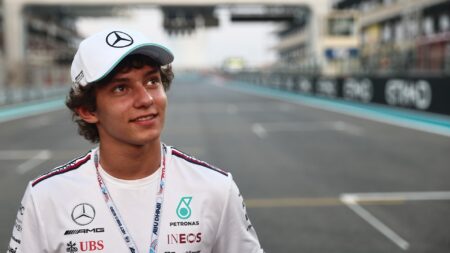
Junior sensation Kimi Antonelli is driving for Mercedes in 2025, replacing Lewis Hamilton – here’s everything you need to know about the young Italian
By
Cambridge Kisby
The first tests in Spain did not provide any reliable indications, although it seemed that Mercedes and McLaren were in pretty good shape. The Ferraris covered a lot of kilometres and in terms of engine reliability – also including those used by Haas and Cadillac – that seems positive.
And in the last of the five days on track (however insignificant those times were), Hamilton stood out. But there is no doubt that, should 2026 not be a big improvement on 2025, anything can happen at the Scuderia.
Did we see some of the old Lewis in the Barcelona shakedown? He said it had been “a hugely enjoyable week – honestly”
Ferrari
Vasseur, team principal, could become the scapegoat. Leclerc has made no secret of the fact that, in the absence of an improvement in race competitiveness, even his almost filial attachment to Ferrari could dissolve and ultimately lead him to a different team – rationality over emotion. In such a negative scenario, Lewis could be the most fragile mechanism.
Unless, of course he goes back to being the Hamilton of the Hamilton era. Miracles sometimes happen, even in racing.