


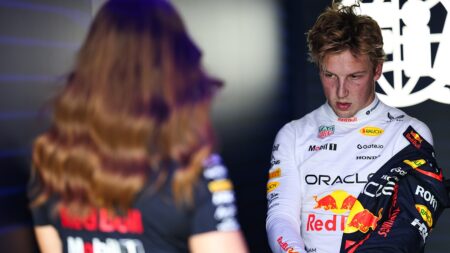
A breakthrough season in 2024 featured Lindblad stepping up to F3, where he became the youngest feature race winner in the series’ history and achieved a historic double victory at Silverstone – the first ever in the modern FIA F3 format. He finished the year as the highest-scoring rookie and fourth overall.
In 2025, Lindblad moved to Formula 2 with Campos Racing. He quickly established himself as a frontrunner, becoming the youngest race-winner and pole-sitter in series history, claiming victories in Jeddah and Spain, and finishing sixth in the points.
Red Bull’s decision to promote Lindblad came after challenges with its F1 line-up. Liam Lawson’s brief stint in the main team, coupled with Tsunoda’s struggles, left Red Bull looking for its next star.

New kid on the block, literally. After a meteoric rise Lindblad will become one of F1’s youngest entrants
Why the early superlicence?
The FIA’s rules stipulate that drivers must be at least 18 to have a superlicence, which allows them to race in Formula 1. However, Lindblad was awarded his superlicence last June, a few months before his 18th birthday in August 2025 after Red Bull applied for an exemption.
Lindblad already had the 40 points required (earned through high championship finishes), and the licence enabled him to take part in the Silverstone practice session. He would also have been able to replace a regular F1 driver if needed. At the time, world champion Max Verstappen’s penalty for his clash with George Russell in the Spanish Grand Prix brought him close to a race ban.
According to the FIA, Lindblad “has recently and consistently demonstrated outstanding ability and maturity in single-seater formula car competition.”
How could he adapt to life in F1?
Red Bull’s Junior Team has form in this area, promoting drivers often considered ‘too young’ in the olden days directly into prime grand prix seats. It’s a sink or swim programme, which boasts a suitably chequered history on that front.