More than 50 years since a bright yellow Porsche took centre stage at the 1973 Canadian Grand Prix, we look back at the history F1 safety cars and the role that they have played in races
Fiat Tempra: pace car for the 1993 Brazilian Grand Prix
More than 50 years ago, Jody Scheckter and Francois Cevert unknowingly made history: clashing on lap 32 of the 1973 Canadian Grand Prix, blocking the circuit and forcing the deployment of F1’s first safety car.
The Porsche 914 that emerged on track was the forerunner to the Mercedes supercar that shepherds this season’s races but that first appearance could easily have caused the whole concept to have been scrapped: what was then called the pace car actually added to the chaos caused by the on-track crash.
The idea persisted and, after extensive rule changes and several manufacturer swaps, the safety car has since become a major part of race weekend proceedings. It remains integral to driver and track safety. Of course, it’s still causing controversy to this day.
Here’s a history of F1’s safety cars and how they have developed since that day in 1973.
The first F1 safety car
F1’s safety car emerged from tragedy: the needless death of Roger Williamson who was trapped in the blaze of his overturned March at the 1973 Dutch Grand Prix. New rules on fire safety were introduced, but so too was a novel procedure to be implemented after a serious accident when the track was partly blocked, or drivers needed assistance.
Drivers had accused each other of variously driving too fast or too slow through the smoke of Williamson’s car, and so the “pace-car rule” was born.
“Yellow and white flags will be shown and this signal will be passed all round the circuit in both directions by visual contact between marshals,” wrote Denis Jenkinson in Motor Sport‘s October 1973 issue. “This immediately ‘freezes’ the race and stops all passing by competitors, and meanwhile the pace-car sets off from the pits, clearly recognisable by flashing lights and bright colours. It circulates round the track at a nominal 60-70 mph and when the race leader catches it up he lines up behind it, the rest of the field catching up and falling in behind.”
The principle has changed little in the past 50 years, although thankfully, the speed of the safety car has.
High-drag spec for Porsche safety car
DPPI
Its first test came at the 1973 Austrian Grand Prix where the very first safety car, a Porsche 914 carried out two “dry runs”. “What a sad reflection on the mentality of the world’s best drivers,” wrote Jenkinson. “If the Grand Prix elite need to be disciplined like this, what of the newcomer and novice driver?”
He also raised a question that would come back to haunt Formula 1 in the final race of the 2021 season. “What would happen if there was an accident in the last few laps of a race; would the pace-car receive the chequered flag and would the driver get championship points!”
The 2021 Abu Dhabi finale was far from the first time that the safety car caused controversy. The complaints rolled in from its very first grand prix appearance.
The first grand prix to feature a safety car
The first F1 safety car deployment didn’t exactly go to plan
YouTube
With the Austrian test complete, the yellow Porsche 914 was ready for action, and it would make its race debut two grands prix later at Mosport Park in the 1973 Canadian Grand Prix.
A red flag looked to have prevented a safety car finish at the Australian Grand Prix — until a pile-up at the restart saw drivers process to the chequered flag. How far should F1 go to ensure cars race to the end? asks Adam Cooper
By
Adam Cooper
Torrential rain flooded the circuit as the race got underway, allowing some new stars to shine through in the awkward conditions — a young Niki Lauda taking the lead on lap three after qualifying eighth. But then came the chaos.
A rapidly drying track forced the majority of the field to pit for slick tyres and after Scheckter and Cevert’s clash, a recovery vehicle was brought out on track to pick up some of the debris. Both instances caused utter confusion in the running order, and in an attempt to regain control of the race, organisers deployed what was then called the pace car on lap 32. It pulled out ahead of Howden Ganley — who had initially been running in 23rd place.
As the Porsche re-entered the pitlane and the final 45 laps of the race were run, it became more and more unclear who the race leader really was. Some thought it to be Emerson Fittipaldi, others claimed Jackie Oliver but it was Ganley’s Williams that initially took the chequered flag.
Jody Scheckter’s McLaren wrecked at the side of the road helped make history: the deployment of F1’s first safety car
Grand Prix Photo
Several hours after podium celebrations and scouring lap charts, it appeared some cars had skipped the safety car queue amid the chaos and completed one more lap than the rest of the field. Peter Revson was officially declared the winner, with Fittipaldi in second Oliver in third.
Given its turbulent introduction, it’s little surprise that the safety car’s appearances were sporadic for several years. it didn’t appear again until the 1976 Monaco Grand Prix — a Porsche 911 now leading the pack — and many still doubted the need for one at all.
1980s: an exotic era for F1 safety cars
Widely regarded as Formula 1’s jewel in the crown, the Monaco Grand Prix has always been about the spectacle — the glitz and glamour of the principality on full display since 1950. So why not have a safety car to match?
From 1981-1983, a Lamborghini Countach made some cameo appearances across the race weekend but was never deployed during the grand prix itself — its 4.0-litre V12 instead reduced to the odd parade lap.
Another wouldn’t be seen on track for the next decade.
Safety cars are re-introduced — with a twist
It wasn’t until 1993 that safety cars became a permanent fixture at every race weekend, after the idea was retried at the British and French Grands Prix in 1992 where Ford provided an extravagantly-winged Escort Cosworth.
But rather than using one manufacturer to supply a safety car throughout the Formula 1 season, each race organiser was responsible for supplying their own — leading to some interesting choices.
A mixture of road cars (some sporting, some less so) were the first alternatives among many: a Fiat Tempra 16v featured in the 1993 Brazilian Grand Prix; a Honda Prelude in the 1992 Japanese Grand Prix and an Opel Vectra during Imola‘s tragic 1994 weekend. Although fan favourites, not all were equipped for the task of leading a snarling pack of F1 cars.
From the 1996 season onwards — after the Argentine Grand Prix had used a Renault Clio Williams — Formula 1 took control of safety car supply, and signed an agreement with Mercedes.
More muscle for F1 safety cars
F1’s most popular safety car: the Mercedes SLS AMG
Grand Prix Photo
The Mercedes-Benz C36 AMG was a significant initial upgrade over its safety car predecessors, boasting a 3.6-litre engine and a top speed of over 155mph — more adequate for F1 speeds, although drivers continued to complain about its lap times.
It was upgraded again 1998, with the more powerful CLK 55 AMG until 1999.
With the car itself now in good hands, the next step was to find the correct driver — someone who could keep the necessary pace required by the field of drivers behind, so that tyres wouldn’t go cold and engines wouldn’t overheat. Enter Bernd Maylander — a former DTM driver and winner of the Nürburgring 24 Hours.
The German was behind the wheel of several F1 safety cars during his first decade on the job — driving a Mercedes-Benz CL55 on his debut at the 2000 Australian Grand Prix, before moving into the SL55 AMG (2001-2002), the CLK 55 AMG (2003), the SLK 55 AMG (2004-2005), the CLK 63 AMG (2006-2007) and finally the SL 63 AMG (2008-2009).
The gull-winged Mercedes SLS AMG joined the grid between 2010 and 2014, with a top speed of well over 200mph, once again piloted by Maylander.
F1’s current safety car
Bernd Maylander has been F1’s permanent safety car driver since 2000. In 2026 he took the wheel of Mercedes’ latest model – in a one-off special livery for the Hungarian Grand Prix
Mercedes
From 2015 onwards, the Mercedes-AMG GT joined the line-up, but there was a shake-up in 2021 when the traditionally silver safety car painted red to aid driver visibility and the role was split between the German brand and Aston Martin, which runs its cars in traditional green livery. Maylander, once more was responsible for getting them around the track fast and safely
Both manufacturers also supplied medical cars that commonly trail the field on the opening lap in case of an accident — Mercedes using its AMG GT 63 S 4MATIC+ model while Aston use its new DBX707.
The former was the first car on the scene for Romain Grosjean‘s horrific crash at the 2020 Bahrain Grand Prix — the aid it provided being a critical reminder for why safety and medical cars are still of great importance to F1 and its drivers.
Aston Martin withdrew from the arrangement at the end of 2025, and Mercedes is now the sole safety car supplier, with the latest version of the Mercedes-AMG GT 63 PRO 4MATIC+, which is the first official safety car with four-wheel drive, channelling 603bhp in conditions that can be treacherously wet.
Safety car controversy in 2021
Speeded up safety car procedure in Abu Dhabi has left long shadow for F1
Giuseppe Cacace/AFP via Getty Images)
Virtually every safety car deployment affects racing, with the potential for controversy. It was the catalyst for Crashgate in 2008: Fernando Alonso pitting early at the Singapore Grand Prix before his team-mate Nelson Piquet Jr deliberately crashed. At that time, the pitlane was closed when the safety car was deployed, which allowed Alonso to close up to the rest of the field and then breeze past as they all pitted when the race resumed.
A similar to (but legal) effect helped Pierre Gasly win the 2020 Italian Grand Prix. When Kevin Magnussen stopped just by the Monza pitlane entrance, Gasly made a quick stop, just before a safety car was deployed and the pitlane closed to allow Magnussen’s Haas to be cleared. Once the rest of the field stopped, Gasly took advantage and won.
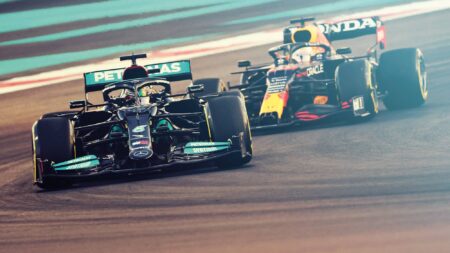
But, for most fans, mention of safety car controversy reignites the memories of Abu Dhabi 2021, when — as Jenkinson forecast 48 years previously — a late safety car led to the prospect of the race finishing in formation, not just deciding the winner of the Grand Prix, but also that year’s champion.
It would have meant an underwhelming end to a thrilling and tense season where Lewis Hamilton and Max Verstappen had battled to the bitter end. Hamilton had the edge for most of the Yas Marina race, and was leading when the safety car emerged.
It should have been a showcase for Formula 1, but the 2021 Abu Dhabi Grand Prix title decider turned into a farce. Plenty has changed following the event, but issues — and rivalries remain
By
Dominic Tobin
However, Verstappen in second was able to pit without losing position — not an option open to Hamilton. He was in the train behind his championship rival with far fresher tyres.
Not that this should have mattered: there were not enough laps to follow the standard safety car procedure which allowed backmarkers to unlap themselves and rejoin the back of the train.
But race director Michael Masi decided to speed up that process to allow a final lap of racing. Given the difference in tyre compounds, it was almost inevitable that Verstappen would pass Hamilton and become champion.
Races that finish behind the safety car
The fallout from Abu Dhabi 2021 saw Masi lose his job and the safety car procedure revised. But F1 still hasn’t found a perfect solution. Italian fans were denied the prospect of seeing Charles Leclerc make a last-ditch bid to win the 2022 Italian Grand Prix as it finished under the safety car. Plenty of fans thought a red flag followed by a restart would have been more apt.
Four years later at Silverstone, fans watched an anti-climactic end to the 2026 British Grand Prix, as Charles Leclerc led the field in trundling behind the safety car.
Rather than stopping the race when Max Verstappen crashed out with four laps to go, the safety car was deployed, and it always looked unlikely that there would be enough time to clear the scene, allow lapped cars to pass the safety car and then restart the race.
But fans were given false hope when a message appeared on TV screens announcing that the safety car would be coming into the pits, leaving one final racing lap and a grandstand finish. But it had been displayed erroneously, and the atmosphere quickly fell flat.