


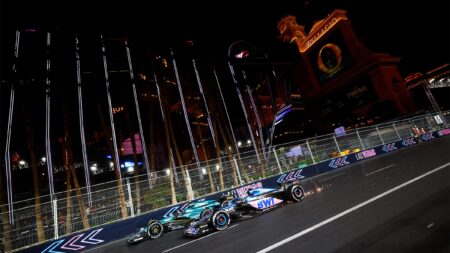
Dimensional changes include a 200mm wheelbase reduction from 3600mm to 3400mm and a 100mm width decrease to 1900mm. These changes are aimed at making the cars more responsive and better suited to close racing, addressing criticisms that cars had become too wide and heavy, particularly for narrow circuits. The new chassis regulations will allow teams more aerodynamic freedom than initially planned, after feedback that early concepts were too restrictive and could make the cars too slow.
Downforce levels are expected to be reduced by 30% and drag by 55% compared to last year’s cars, meaning less reliance on ground effect and more on the clever use of active wings in the hope of having cars that are more raceable.

The introduction of active aerodynamics – allowing drivers to switch between high-downforce (corner mode) and low-drag (straight mode) – is designed to improve straight-line speed, reduce fuel consumption, and allow drivers to follow each other more closely through corners.
Tyres will also be narrower by 25mm (front) and 30mm (rear), although the current 18-inch rim size will remain unchanged. The diameter of the tyres will also decrease from 720mm to 705-710mm. The new Pirelli tyres were already tested on track by Aston Martin late in 2024 ahead of their introduction in 2026.
Visually, the 2026 F1 cars are expected to look sleeker, narrower, and more compact out on track.
| Year(s) | Min.
weight (kg)
| Notes/Regulation Changes
| |
| 1961–1965 | 450 | First official minimum introduced (1.5L engines) |
| 1966–1972 | 500 | Minimum increased with 3.0L engines |
| 1973–1980 | 575 | |
| 1981–1982 | 585 | |
| 1983–1987 | 540 | Turbo era |
| 1988 | 540 | |
| 1989–1993 | 500 | |
| 1994 | 505 | |
| 1995–2008 | 595 | Driver weight included from 1995 |
| 2009 | 605 | |
| 2010 | 620 | Refuelling banned |
| 2011–2012 | 640 | KERS widely used |
| 2013 | 642 | |
| 2014 | 691 | Hybrid V6 engines introduced |
| 2015–2016 | 702 | Anti-intrusion panels added |
| 2017 | 728 | Wider wheels and tyres |
| 2018 | 734 | Halo safety device introduced |
| 2019 | 743 | 80kg driver allowance |
| 2020 | 746 | Second fuel flow meter added |
| 2021 | 752 | |
| 2022–2024 | 798 | 18-inch wheels, ground effect cars |
| 2025 | 800 | 82kg driver allowance |
| 2026 | 768 | Chassis and tyre mass reduced, new regulations |

Rivals have complained about Mercedes’ PU and its compression ratio
Engines
The new power unit regulations represent the most significant overhaul since the introduction of hybrid engines in 2014.
These changes aim to improve raceability and enhance sustainability as they closely align the series with broader automotive industry trends. Below is a detailed analysis of the key technical shifts and their implications compared to the current generation of engines.
1. Power unit architecture
Redesigned hybrid system
The 2026 engines retain the 1.6-litre V6 turbocharged internal combustion engine (ICE) but eliminate the Motor Generator Unit-Heat (MGU-H), a component that recovers energy from exhaust gases. This helps simplify the power unit and reduce costs, but introduces challenges in managing turbo lag, as the MGU-H previously spooled the turbocharger.
To compensate, the MGU-K (Kinetic Motor Generator Unit) has its output nearly tripled from 120kW to 350kW, enabling it to provide both energy recovery and torque fill during acceleration.
Power distribution
Previous ICE dominance: around 80% ICE (550–560kW) vs 20% electric (120kW). The 2026 balance: Near 50-50 split between ICE (400kW) and electric (350kW). Total power remains similar at around 750kW (1006bhp), but the electrification shift aligns F1 with road-car sustainability goals.

2. Energy recovery and deployment
Enhanced recuperation
Energy recovery during braking doubles from 4MJ to 8.5MJ per lap, with the MGU-K solely responsible for harvesting. This forces teams to optimise mechanical braking systems and energy deployment strategies. The removal of the MGU-H eliminates around 60% of the previous energy recovery capacity, requiring innovative solutions to maintain efficiency.
Manual override mode
A new ‘Override Mode’ allows drivers to deploy an extra 0.5MJ of energy when within one second of a rival, mimicking the KERS push-to-pass system used from 2009–2013. This aims to improve overtaking by granting following cars a 350kW burst up to 337km/h.
Turbo lag and energy management
Without the MGU-H, turbo response delays could necessitate using the MGU-K to spool the turbocharger, consuming precious electrical energy. Simulations suggest cars may face ‘lift-and-coast’ scenarios on power-sensitive circuits like Monza if energy management is suboptimal.

DPPI
3. Sustainability and fuel innovations
100% sustainable fuels
Engines will use fully sustainable fuels derived from non-food biomass, municipal waste, or carbon capture. This replaces the current E10 blend (10% ethanol) and eliminates fossil carbon emissions produced by the cars. The FIA’s fuel certification scheme ensures compliance with strict greenhouse gas reduction targets.
| Specification | Previous generation (2014-2025) | 2026 generation |
| Internal combustion engine power | 550-560 kW (736-750 hp) | 400 kW (536 hp) |
| Electric power (MGU-K) | 120 kW (161 hp) | 350 kW (469 hp) |
| Total power | 750 kW (1,006 hp) | 750 kW (1,006 hp) |
| Electric power share | 16% | 47% |
| MGU-H System | Yes (MGU-H present) | No (MGU-H removed) |
| Energy recovery per lap | 4 MJ per lap | 8.5 MJ per lap |
| Fuel flow rate | 100 kg/h (mass flow) | 3,000 MJ/h (energy flow) |
| Fuel type | 10% sustainable fuel (E10) | 100% sustainable fuel |
| Minimum weight (ICE) | 145 kg (includes MGU-K MGU-H) | 130 kg (excludes MGU-K) |
| Turbocharger Max RPM | 125,000 rpm | 150,000 rpm |
| Engine Max RPM | 15,000 rpm | 15,000 rpm |
Which engine every F1 team will use in 2026
McLaren – Mercedes
McLaren will continue to use Mercedes power units for the 2026 season and beyond. The team renewed its partnership with Mercedes-Benz in 2023, securing a deal that extends through to the end of the 2030 season.
Red Bull – Red Bull Powertrains
Red Bull will use its own power units through the creation of Red Bull Ford Powertrains. This year marks the debut of Red Bull’s own in-house power unit, developed at its Milton Keynes facility in partnership with Ford, which is returning to Formula 1 as a technical partner after a two-decade absence.
Ferrari
As it has during the entire history of Formula 1, Ferrari will continue to use and supply its own power units.
Mercedes
Like Ferrari, Mercedes will be powered by its own engines in 2026.
Williams – Mercedes
Williams will continue to use Mercedes power units from the 2026 season onwards, having extended its long-standing partnership through at least the end of 2030.
Racing Bulls
Like sister team Red Bull, Racing Bulls will use the Red Bull Ford Powertrains engine in 2026.
Haas – Ferrari
Haas will again use Ferrari power units. The American team extended its technical partnership with Ferrari through the end of the 2028 season.
Aston Martin – Honda
Aston Martin is another team that will change engine supplier in 2026, switching to Honda power units in an exclusive full works partnership with the Japanese manufacturer.
Audi
The Sauber team has become Audi’s works F1 squad and will therefore switch from Ferrari to Audi engines for the German manufacturer’s maiden season in F1.
Alpine – Mercedes
Alpine will use Mercedes power units and gearboxes from 2026 onward after signing a multi-year agreement that runs at least until the end of 2030. This marks a major Shift for the team, as Renault has cancelled its F1 engine programme.
Cadillac – Ferrari
Cadillac will join the F1 field as the 11th team and will use Ferrari engines and gearboxes for its First three seasons (2026–2028) before switching to a power unit from parent company GM.

Cars will be slower
Formula 1 bosses have pushed back against suggestions that the 2026 cars will drift towards Formula 2-level performance, but they are clear on one point: this year’s machinery will be slower, and that’s entirely by design.
FIA single-seater technical director Nikolas Tombazis dismissed some driver claims about the cars having F2-like pace, stressing that current simulations put the new season’s cars roughly one to two seconds slower than last year’s.
He also made no attempt to hide the underlying reality: the start of every major rules cycle brings an intentional performance reset. “I think comments about Formula 2 pace are way off the mark,” Tombazis said last year. “We are talking about laptimes overall, which are in the region of one or two seconds off where we are now, depending on the track, depending on the conditions. And, obviously, at the start of a cycle, it would be silly to be faster than the previous cycle. It would cost us nothing from a regulations point of view, it would be very easy to make the cars go faster.
“But one has to gradually claw back what is gained by natural development. So you can’t start the cycle going faster than the previous one. Then, you know, in 20 years from now, you can imagine what would happen. So I think it’s natural that the cars are a bit slower, but I don’t think we are anywhere near the ‘it’s not a Formula 1 car’ discussion.”
Slowing the cars is the only way to stop each era ending with speeds the championship can no longer safely contain.
Formula 1’s performance curve always rises as a set of rules matures. Teams refine aerodynamic concepts, understand how to exploit grey areas, and unlock efficiencies that the original regulations never predicted.
If each cycle began faster than the one before, that curve would quickly spiral into something unmanageable. That’s part of the reason why the FIA builds in a reset at the start of each era. The 2009, 2014 and 2022 overhauls all delivered slower cars initially before development rapidly clawed back the deficit. For the governing body, the reset is a tool to control long-term speed escalation while still allowing teams the freedom to innovate.
Circuit limits and cornering speeds
The most fundamental constraint is physical: the circuits themselves. Modern F1 cars spend huge portions of the lap in high-speed corners, producing lateral forces that push the limits of what drivers, tyres and safety infrastructure can handle.
Increasing downforce year after year eventually forces the FIA to intervene, either by redesigning the tracks or rebalancing the cars. That’s why the 2022 rules were introduced in the First place: the 2017–21 cars had become so aerodynamically extreme that the championship risked outgrowing its venues. A smaller, slightly slower starting point was necessary to keep cornering speeds in check. The 2026 technical package continues that logic. Under the new hybrid regulations, laptimes will vary more sharply depending on how easily a circuit allows the power unit to harvest and deploy energy.
Red Bull’s Paul Monaghan explained that the difference will be central to interpreting 2026 pace. “We have what we might term energy-rich circuits and energy-poor circuits,” Monaghan explained last season. “So it’s easier to fill the energy store on some tracks. And then the laptime is a little bit slower. Some of the poorer ones, we’re struggling a little bit at the moment – we’re a bit more than that off. But one of the great difficulties at the moment is trying to actually establish how much grip we’re going to have. We can have an aero map, and it says we’ll make this level of downforce – is it actually reality? So, yes, they’ll be a little bit slower. I don’t think we’ll be Formula 2-paced. I hope not. So that’s where we would be.”
Tyres: the biggest unknown
The new cars began development before the final Pirelli tyres were signed off, leaving a major source of uncertainty baked into every simulation.
“Once we have the final tyres from Pirelli, maybe they’re a little bit better, a little bit worse,” Monaghan said. “And it has quite a knock-on effect to your overall laptime.”
Mercedes’ deputy technical director Simone Resta added that even with mule-car testing, teams still don’t have a definitive answer on how the tyres will behave with the new chassis and power unit. “There’s a lot to learn in every area, including electronics, the new control unit and so on,” he said.
Grip levels alone could shift laptime by multiple seconds across a race weekend, a reminder that the tyres have the potential to define more of the performance window than aerodynamics or engine power alone.

2025: Venturi tunnels encouraged downforce grip

2026: Flat floor means ground effect is greatly reduced
Slower doesn’t necessarily mean worse
The consistent message from engineers is that while 2026 will begin with slower cars, that’s not a downgrade. It’s an opportunity.
“With these cars, we keep thinking we’re approaching the asymptote, and then we go and find new avenues to explore,” Monaghan said. “But with a new set of regulations and our new engine as well, there’s all sorts of opportunities to find ways to improve it. I think the scope of work will be quite significant, but the opportunities are big. As long as we can do a half-decent job and keep ourselves in a good shape, we’ll see where we are.”
Resta echoed him: “The best teams will be the ones learning quicker and reacting quicker at the start of the season.”
Shorter braking zones, simplified aero, new energy deployment patterns and the inevitable rapid development curve will all give teams fresh avenues to explore. And soon, possibly before year two of the new rules cycle, the laptime deficit will almost certainly be gone.

Could this be the end of the classic long straight, late brake overtake?
DPPI
Overtaking rebooted
Overtaking has always been the most analysed, argued-over currency in F1, but 2026 will drag it into an entirely different system.
The championship will enter its first post-DRS era, and for the first time in more than a decade, drivers will no longer have a guaranteed, repeatable passing mechanism. In its place comes something more complex, less predictable and potentially far more human: a race built around energy management, deployment timing, driver-controlled active aerodynamics and a new set of offensive and defensive modes that could redefine what wheel-to-wheel looks like.
While the 2026 rules promise lighter cars, shorter wheelbases, and less turbulent wake – all elements that theoretically promote closer racing – overtaking itself becomes harder to map.
One of the biggest changes underpinning this shift is the new active aerodynamics, with drivers able to switch between a high-downforce configuration for corners and a low-drag, low-downforce configuration for straights. This system will be available on every lap to every driver, effectively giving all competitors a straight-line speed boost rather than a defined overtaking aid.
The adjustment isn’t purely about passing, however – it’s also about managing energy consumption in a power unit era that’s roughly half electric, where minimising drag on the straights can help preserve battery and overall efficiency.
This change means drivers now have an additional strategic layer to master: not just when to harvest and deploy electrical energy, but also when to switch aero modes to maximise their chances of positioning themselves for a move — or defending against one. The new hybrid framework places far more of the workload back into the cockpit.
Drivers will control how much battery they harvest on approach to a corner, how much they deploy on exit, and how aggressively they defend when the car behind chooses to attack. It turns the act of overtaking from something automated into something expressive.
Early driver feedback hints at the scale of the reset. Several have suggested that the classic long-straight, heavy-braking pass might no longer be the default, predicting that moves could appear in what today look like ‘obscure’ corners – places where a rival runs out of electrical energy or misjudges their harvesting. Little lapses in energy timing could be punished instantly. The loss of DRS could force an entirely new vocabulary of moves into existence.
“I think the way the rules are at the moment, they will be busier in the cockpit,” said Williams team boss James Vowles last year. “I don’t think that’s a bad thing. I think you’ll get those that come out on top as a result of it — those that are completely in control of the car and its behaviours and then thinking outside the box.
“The areas that are different… probably the right way of putting it to you is, you can almost fill the entire battery in one braking zone, but you can deplete it in one straight. That’s for sure. And so that creates a very different dynamic to [last] year.”

Two active flaps on the front wing can be opened, below, to give more speed

Closed for slow speed but opened, above, for low drag – and overtaking
Multi-layered energy racing
Where the current era is built around a simple attacker’s advantage – the car behind gets the drag reduction and can launch a move – the 2026 concept is built on mutual optionality.
Both drivers will have offensive and defensive modes through the lap. The car behind can deploy aggressively to force a gap; the car ahead can answer back with its own defensive squeeze of electrical power. Suddenly, the pass becomes a negotiation rather than a foregone conclusion.
That negotiation is already being felt inside teams. After months of simulator work on early car models, Vowles says drivers went through a rapid evolution in how they understood the new racecraft. “The overtaking will be different, but it will happen,” Vowles explained. “It’ll just be in a different way to what you’re used to. The drivers had a go once and thought, ‘this isn’t great.’ Then the second time, went, ‘that’s interesting.’ Then by the third or fourth time – as they’re race drivers – they were really into it. And there’s a very different way of optimising it as a solution, and they can see how the advantage can come in.”
That idea – that overtaking becomes a learned skill rather than a pre-defined exchange – is central to how teams see 2026 unfolding. As Vowles put it, the learning curve is steep and ongoing. “The challenge is that everything changes. There’s a lot of learning we’re going through almost week by week, especially on the energy side — how do we use it in the most efficient way possible?”
The result is a racing model where overtaking depends less on geography and more on timing. Opportunities may emerge where no one expects them. Conversely, famous passing points may become easier to defend.

Drivers can expect to be a lot busier this year, using battery systems to facilitate attack and defence
How overtaking zones might change
One of the most intriguing consequences of the new rules is that circuits could develop ‘dynamic’ overtaking zones – places that only become viable when a driver’s energy window is favourable. Instead of DRS straights being baked into the race narrative, each lap might carry its own set of passing hotspots.
Vowles said that manual energy deployment and active aero will shift overtaking opportunities to unexpected areas. “You’ll probably protect the regions with energy deployment where overtaking is most likely to happen. So, taking Monaco, I think it’s unlikely you’ll get a differential through there. But I think you’ll move away from, say, Spa – your typical overtaking point is, for example, up into Turn 5. That’s one of the main areas. Actually, it opens up the door for a few other areas around that lap.”
That line – “it opens up the door” – is essentially the basis of the new rules. Traditional passing zones may remain important, but they lose their monopoly. The interplay of harvesting, deployment, and active aero could produce opportunities elsewhere, in smaller corners, in rhythm sections, or in places where the delta is created by battery cycles.
Shorter straights, usually dismissed as transitional pieces of a lap, could become overtaking zones. A rival emerging from a technical sequence with insufficient harvest may find themselves vulnerable on even a 200-metre burst to the next braking point.
Drivers have hinted that these ‘non-corners’ and mini-straights might become the real battlegrounds, especially early in the season when teams are still discovering optimal deployment and aero strategies. Even mid-corner behaviour may shift. With the hybrid system’s greater reliance on harvesting under braking and coasting, the energy state of a car at turn-in becomes a tactical variable.
A driver who has harvested aggressively into the previous corner might enjoy better traction on exit; one who has been forced to defend earlier in the lap might be caught flat-footed as the electrical system rebuilds. Suddenly, a corner that has never hosted an overtake might open up for a decisive lunge because one driver’s battery window fell at the wrong moment.
Active aero isn’t just a replacement for DRS – it fundamentally changes how cars approach racing. Drivers will be thinking not just about slipstream and braking points, but about when to toggle aero states and how their energy strategy intersects with those decisions.


